Advertisement
FKF summons Kariobangi Sharks for disciplinary action over court case
02nd September, 2026 08:26 PM

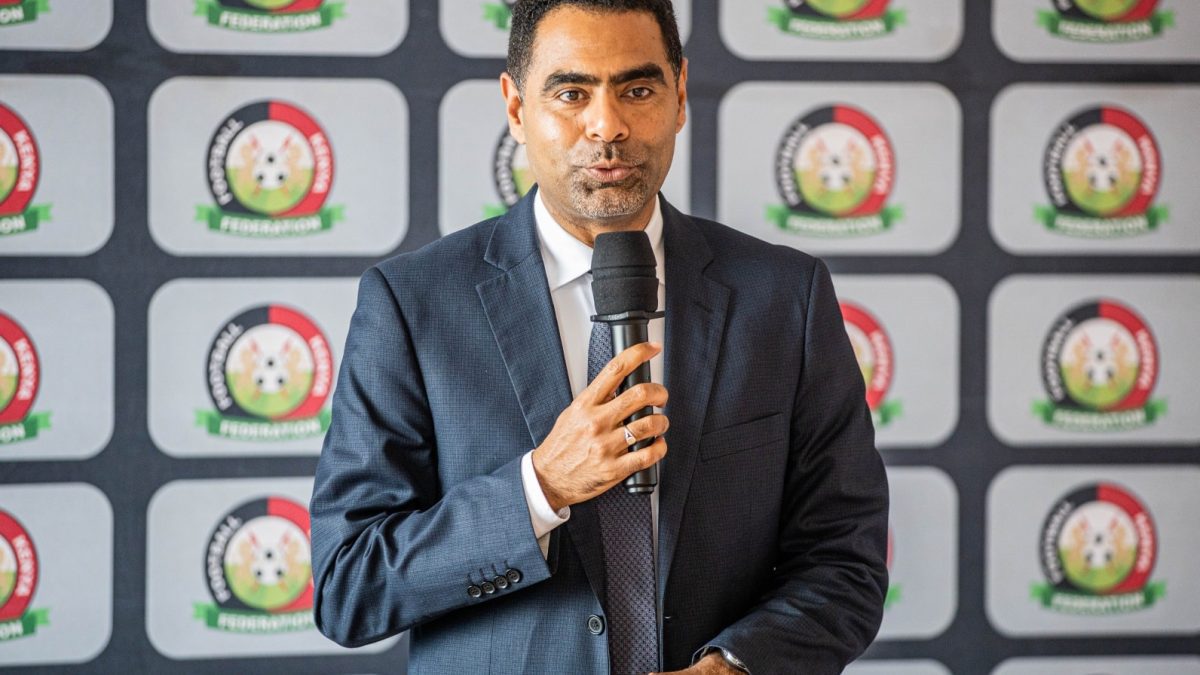
Football Kenya Federation (FKF) has called Kariobangi Sharks before its Disciplinary Committee following the club’s decision to challenge a football-related ruling in the High Court.
Sharks are expected to appear before the committee on Thursday, September 3, 2026 to respond to allegations that their court action has brought the sport into disrepute.
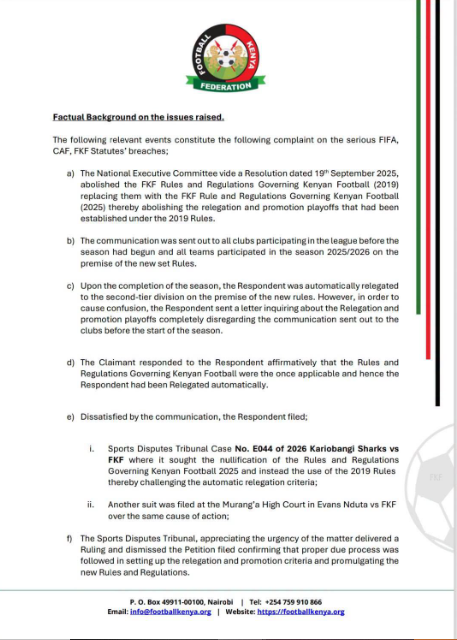
The dispute stems from a Sports Disputes Tribunal (SDT) decision that supported the application of the 2025 FKF regulations. The ruling ultimately contributed to Kariobangi Sharks being relegated.
Unhappy with the Tribunal’s decision, the club approached the High Court seeking to challenge it. The court subsequently issued orders that have put the scheduled opening of the FKF Premier League on hold.
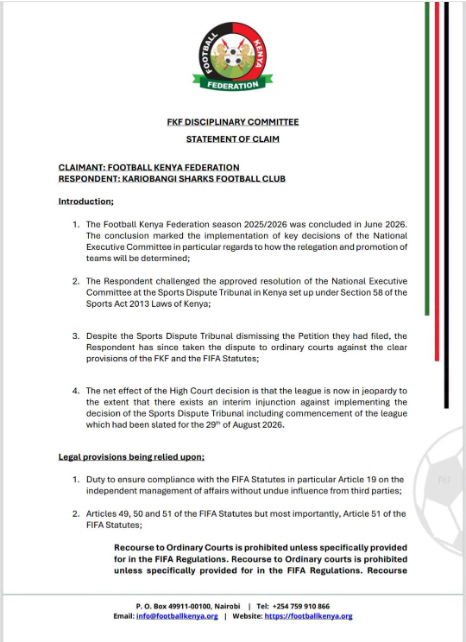
FKF now wants the club to explain why disciplinary measures should not be taken against it for bypassing the football-specific dispute resolution mechanisms and turning to the ordinary courts.
However, the federation’s move against Sharks has itself raised a number of questions, particularly concerning FKF’s current judicial and administrative structures and its previous conduct in similar circumstances.
Which FKF tribunal will handle the case?
One of the biggest questions surrounding the proceedings is the identity of the judicial body that will actually determine the case.
FKF recently abolished its existing judicial structures through a decision of its National Executive Committee. The replacement structures, however, have yet to be established.
That leaves uncertainty over which FKF judicial organ has the legal and administrative mandate to hear the disciplinary case against Kariobangi Sharks.
The issue could become significant if Sharks challenge the validity of the process or the authority of the committee handling the matter.
Who authorised the disciplinary proceedings?
Another question relates to the federation’s leadership structure.
The CEO ordinarily has an important administrative role in the federation, including the communication and processing of matters involving its judicial structures.
With that office vacant, questions are likely to arise over who initiated the proceedings against Sharks, what procedure was followed and under whose authority the disciplinary action was commenced.
FKF has previously challenged an SDT decision in court
The federation’s current position on the Sharks case also appears complicated by its own previous decision to approach the High Court.
In January, FKF went to the High Court after an SDT ruling in the dispute involving Nairobi United and Gor Mahia did not favour the federation’s interpretation and application of the 2025 FKF regulations.
FKF sought judicial review of the Tribunal’s decision.
The development is significant because the federation is now questioning Kariobangi Sharks for taking an SDT-related dispute before the High Court.
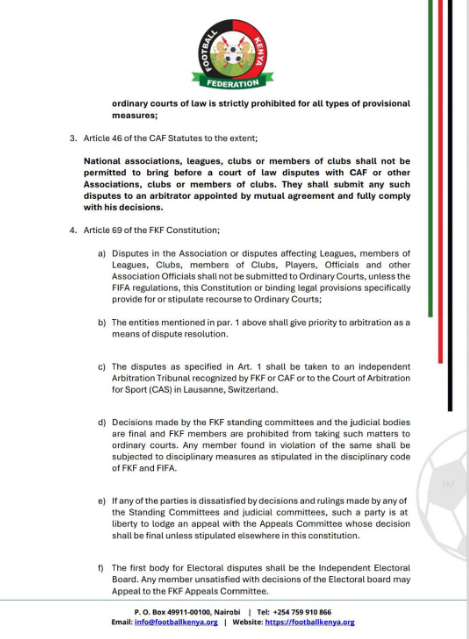
FKF’s argument is that football disputes should be handled through the established sporting dispute-resolution framework, including the possibility of an appeal to the Court of Arbitration for Sport (CAS), rather than being taken to ordinary courts.
The federation’s earlier court action therefore raises questions about whether the same principle was applied consistently when FKF itself was dissatisfied with an SDT ruling.
FKF officials have also turned to the courts
The federation’s history with the ordinary courts provides another layer to the dispute.
Following a decision by the NEC to remove the FKF president, the federation’s CEO and another NEC member, the affected officials sought intervention from the High Court.
They applied for court orders aimed at preventing their removal from office.
That episode further complicates FKF’s argument that resorting to the High Court over an internal football dispute amounts to conduct capable of bringing the game into disrepute.
Sharks case could have wider implications
As Kariobangi Sharks prepares to appear before FKF’s disciplinary authorities, the matter is therefore no longer simply about the club’s challenge to its relegation.
It has also opened a broader debate about the consistency of FKF’s approach to football disputes, the authority of its current judicial structures and the circumstances under which football stakeholders can seek intervention from ordinary courts.
The High Court orders have already disrupted the planned start of the new FKF Premier League season. The outcome of the Sharks disciplinary proceedings could now add another dimension to an increasingly complicated dispute over the administration and regulation of Kenyan football.