Advertisement
Willis Otieno: Defending constitution cannot be equated to poor parenting
15th July, 2025 02:58 PM

Legal expert Willis Evans Otieno has pushed back against claims that defending the Constitution amounts to poor parenting, calling for a national reflection on leadership values and the kind of future Kenya is building for its children.
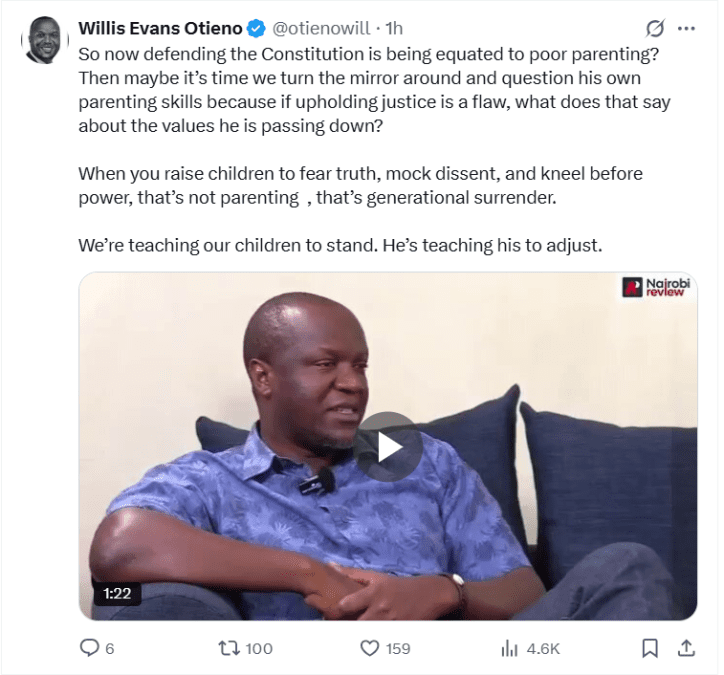
In a hard-hitting post on X, dated July 15, 2025, Otieno questioned recent remarks by President William Ruto, who linked moral decay in society to parenting failures.
This comes amid Rutuo’s remarks that, according to him, parents are to blame, as they not only incite their children but also fail to teach them what is right and wrong.
“I urge parents, please stop inciting your children. That is what is causing the demonstrations and the loss of lives. The biggest problem we have is that parents fear their children and cannot tell them what is wrong and what is right,” Ruto remarked.
But Otieno sees a dangerous conflation between youth activism and moral failure. His response was swift and unapologetic.
“So now, defending the Constitution is being equated to poor parenting? Then maybe it’s time we turn the mirror around and question his own parenting skills because if upholding justice is a flaw, what does that say about the values he is passing down?” Otieno posted.
He went further, warning against teaching children to fear truth, mock dissent, or submit to unchecked power. “When you raise children to fear truth, mock dissent, and kneel before power, that’s not parenting—that’s generational surrender,” he said.
Otieno’s remarks echo broader concerns about leadership integrity and the role of civic engagement in Kenya’s democracy. The historical context deepens the debate. In 2005, Ruto, then aligned with KANU, actively opposed the constitutional referendum, marking the beginning of what Otieno suggests is a pattern of resistance to reforms that promote accountability.
This trend continued in 2010 when Ruto led the anti-constitution brigade during the push for Kenya’s new constitution, positioning himself at the forefront of those who challenged the reform agenda. Otieno argues that this history reflects a consistent reluctance by some leaders to embrace transformative changes that strengthen checks on power.
“We’re teaching our children to stand. He’s teaching his to adjust,” Otieno added, framing the conversation as a clash between resilience and conformity.
His comments have sparked reflection on whether Kenya’s leadership is encouraging active citizenship or grooming a generation to accept the status quo without question.
As the country faces rising public dissent, Otieno’s intervention has struck a chord, pushing the conversation beyond parenting into the core of governance: Are leaders nurturing a culture of courage or of compliance?