Advertisement
Nairobi County to arrest customers buying from hawkers in undesignated areas
24th July, 2025 10:07 PM

Nairobi County has announced a renewed crackdown on illegal hawking in undesignated areas, warning that both hawkers and their customers will now face arrest and prosecution.
The directive, issued by Environment Chief Officer Geoffrey Mosiria, emphasises the county’s commitment to restoring order, cleanliness, and respect for public spaces within the city.
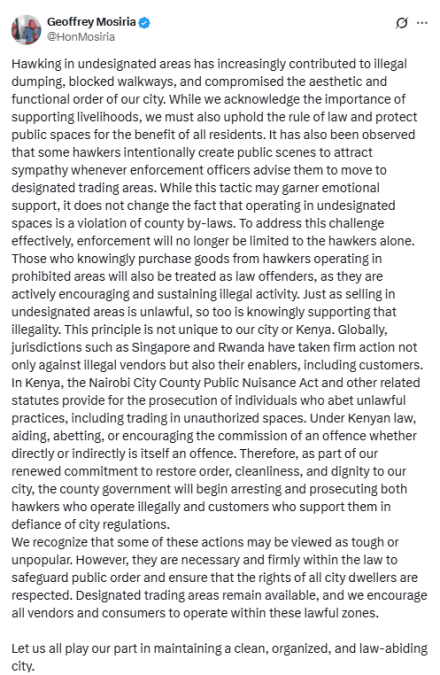
“Hawking in undesignated areas has increasingly contributed to illegal dumping, blocked walkways, and compromised the aesthetic and functional order of our city. While we acknowledge the importance of supporting livelihoods, we must also uphold the rule of law and protect public spaces for the benefit of all residents,” Mosiria’s statement shared via his official X account on Thursday, July 24, 2025, read in part.
The new measures aim to address what the county describes as a persistent challenge—hawkers setting up stalls in restricted zones, often resorting to public displays and confrontations when asked to relocate.
According to Mosiria, some of these scenes are deliberately created to attract sympathy from the public, but such actions, he says, do not absolve vendors from breaking the law.
Customers treated as offenders
In a move that marks a significant shift in enforcement, Mosiria announced that the crackdown will no longer target hawkers alone. Individuals who knowingly buy from street vendors operating illegally will also be treated as offenders.
“It has also been observed that some hawkers intentionally create public scenes to attract sympathy whenever enforcement officers advise them to move to designated trading areas. While this tactic may garner emotional support, it does not change the fact that operating in undesignated spaces is a violation of county bylaws,” Mosiria stated.
“To address this challenge effectively, enforcement will no longer be limited to the hawkers alone. Those who knowingly purchase goods from hawkers operating in prohibited areas will also be treated as law offenders, as they are actively encouraging and sustaining illegal activity.”
Citing the Nairobi City County Public Nuisance Act and other Kenyan statutes, the statement clarified that aiding or abetting unlawful practices is a punishable offence.
Arrests
The county will therefore begin arresting and prosecuting both illegal vendors and their patrons, with the intent of discouraging non-compliance and ensuring order in the city.
While the directive may face criticism for its tough stance, Mosiria defended the policy as necessary and legally sound.
“Just as selling in undesignated areas is unlawful, so too is knowingly supporting that illegality. This principle is not unique to our city or Kenya. Globally, jurisdictions such as Singapore and Rwanda have taken firm action not only against illegal vendors but also their enablers, including customers,” he stated.
“In Kenya, the Nairobi City County Public Nuisance Act and other related statutes provide for the prosecution of individuals who abet unlawful practices, including trading in unauthorised spaces. Under Kenyan law, aiding, abetting, or encouraging the commission of an offence, whether directly or indirectly, is itself an offence. Therefore, as part of our renewed commitment to restore order, cleanliness, and dignity to our city, the county government will begin arresting and prosecuting both hawkers who operate illegally and customers who support them in defiance of city regulations,” Mosiria added.