Advertisement
EPRA announces fuel prices for November cycle
14th November, 2025 06:48 PM

The Energy and Petroleum Regulatory Authority (EPRA) has released the maximum retail prices for petroleum products that will take effect from Friday, November 14, 2025, through to December 14, 2025.
In a statement on Friday, November 14, 2025, the authority revealed that the capped pump prices for Super Petrol, Diesel, and Kerosene will remain unchanged during the period under review.
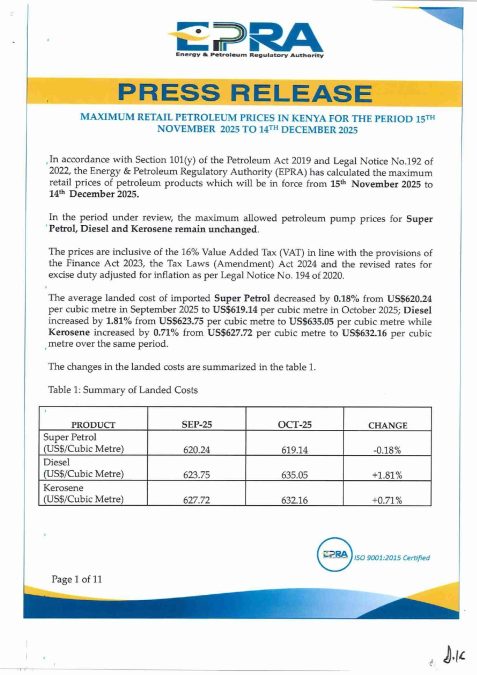
“In accordance with Section 101(y) of the Petroleum Act 2019 and Legal Notice No. 192 of 2022, the Energy & Petroleum Regulatory Authority (EPRA) has calculated the maximum retail prices of petroleum products which will be in force from 15th November 2025 to 14th December 2025,” EPRA wrote.
EPRA noted that the average landed cost of imported Super Petrol decreased slightly, falling by 0.18% from US$620.24 [approximately Ksh81,000] per cubic metre in September 2025 to US$619.14 [approximately Ksh80,023] per cubic metre in October 2025.
Diesel, however, recorded a 1.81% increase, rising from US$623.75 [approximately Ksh80,619] to US$635.05 [approximately Ksh82,138] per cubic metre, while Kerosene’s landed cost grew by 0.71%, moving from US$627.72 [approximately Ksh80,023] to US$632.16 [approximately Ksh81,706] per cubic metre over the same period.
The authority said these changes reflect fluctuations in global fuel costs and are consistent with its mandate under Section 101(y) of the Petroleum Act 2019 and Legal Notice No. 192 of 2022, which ensures transparency and uniformity in fuel pricing across the country.
“The prices are inclusive of the 16% Value Added Tax (VAT) in line with the provisions of the Finance Act 2023, the Tax Laws (Amendment) Act 2024 and the revised rates for excise duty adjusted for inflation as per Legal Notice No. 194 of 2020,” EPRA added.
EPRA added that Kenya imports all its petroleum products in refined form and that international market trends, including the Murban Crude oil prices, international petroleum costs, and the USD-KShs exchange rate, are applied in computing local pump prices.
The authority provided a detailed breakdown of these trends over the last 12 months to illustrate their impact on domestic fuel pricing.
“Kenya imports all its petroleum products in refined form. Petroleum products are traded in international markets based on a pricing benchmark. Trends of international petroleum prices, Murban Crude oil, and the USD-KShs exchange rate have been considered in computing local pump prices over the last 12 months,” EPRA added.
The regulatory body urged fuel marketers to comply with the set maximum prices and reminded consumers that the published rates represent the legal limits for retail sales at pumps across Kenya.
EPRA also highlighted that the Petroleum Pricing Regulations aim to cap the prices of petroleum products already in the country to ensure that importation and other prudently incurred costs are recovered while maintaining reasonable prices for consumers.
“EPRA urges fuel marketers to comply with the set maximum prices and reminds consumers that the published rates represent the legal limits for retail sales at pumps across Kenya. The Petroleum Pricing Regulations cap the retail prices of petroleum products already in the country to ensure that importation and other prudently incurred costs are recovered while maintaining reasonable prices for consumers,” EPRA added.
Author
Steve Ireri
Steve is a senior writer with over four years of experience in digital journalism. His focus is on the showbiz and human interest stories. Emails: [email protected] , [email protected]
View all posts by Steve Ireri