Advertisement
Caleb Amisi: Gachagua’s biggest mistake was alienating Central leaders
08th July, 2025 11:23 AM

Saboti Member of Parliament Caleb Amisi has criticised former Deputy President Rigathi Gachagua for what he termed strategic political missteps that, in his view, have weakened his influence and allowed President William Ruto to tighten control within Central Kenya.
In a post shared on X on Tuesday, July 8, 2025, Amisi said Gachagua’s biggest mistake was “to abuse, ignore, and chastise MPs and other experienced leaders from Central.” According to Amisi, this approach pushed key leaders away and gave President Ruto the opportunity to work with them and sway the Kikuyu community in his favour.
“Now, Ruto has used them effectively to carry on his narrative from within. Pitting Kikuyus against Kikuyus,” Amisi wrote, adding that had Gachagua embraced those leaders early on, they might have helped him build support against the president.
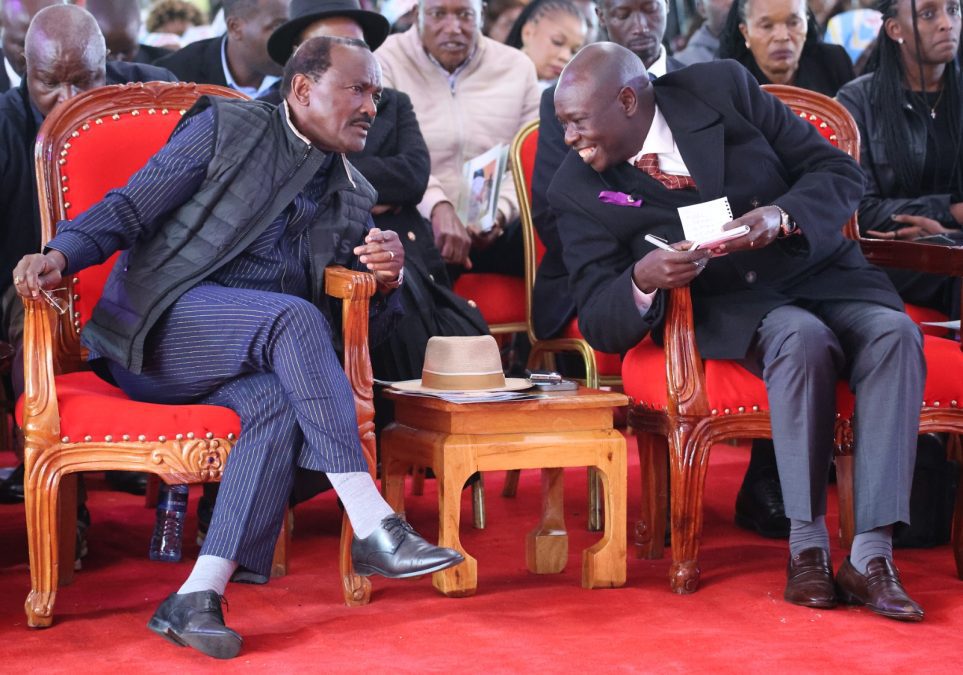
Amisi’s remarks come at a moment of shifting allegiances in Kenyan politics. After his impeachment in October 2024, Deputy President Rigathi Gachagua left the Kenya Kwanza coalition and, by mid‑2025, launched the Democracy for Citizens Party, aligning himself with opposition figures like Kalonzo Musyoka in preparations for the 2027 election.
Mixed reactions to Gachagua’s push
His efforts to consolidate Mt. Kenya leaders under this new banner have met with mixed reception, receiving applause from some regional heavyweights while other established figures remain hesitant or loyal to the government.
The Saboti MP further warned that using ethnic identity as a political strategy in a modern democracy is a dangerous path.
“Selling a community narrative is the easiest tool for a dictator to hang onto power,” Amisi argued. He added that while many Kenyans across different regions are dissatisfied with the president, tribal politics only serve to divide them and hinder collective action.
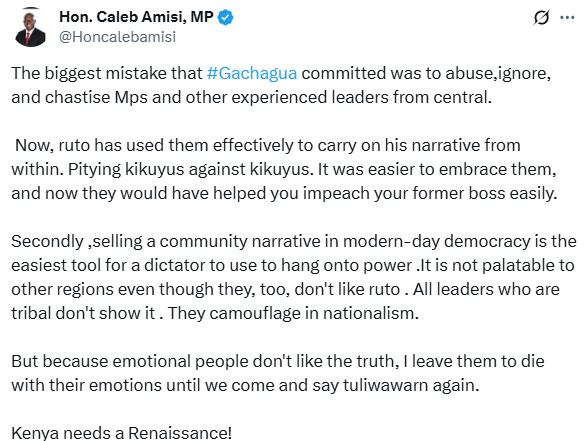
Amisi contrasted this with what he described as more politically savvy leaders, who may still favour their regions but mask their interests under the banner of nationalism.
“All leaders who are tribal don’t show it. They camouflage in nationalism,” he wrote.
In a passionate closing, Amisi called for what he termed a “Kenyan Renaissance”–a fresh start driven by unity, inclusive governance, and forward-thinking leadership.
He criticised those who respond emotionally to hard truths.
“I leave them to die with their emotions until we come and say tuliwawarn again,” meaning “we warned you” in Swahili.
Author
Kenneth Mwenda
Kenneth Mwenda is a digital writer with over five years of experience. He graduated in February 2022 with a Bachelor of Commerce in Finance from The Co-operative University of Kenya. He has written news and feature stories for platforms such as Construction Review Online, Sports Brief, Briefly News, and Criptonizando. In 2023, he completed a course in Digital Investigation Techniques with AFP. He joined K24 Digital in May 2025. For inquiries, he can be reached at [email protected].
View all posts by Kenneth Mwenda