Advertisement
Gachagua loses nationwide support as DCP’s influence falls by 3% – TIFA
23rd December, 2025 01:32 PM

A new TIFA survey shows that former Deputy President Rigathi Gachagua’s Democracy for Citizens Party, DCP, has lost nationwide support as its influence dropped by three per cent.
The survey released on Tuesday, December 23, 2025, shows DCP support fell from 9% in September to 6% in November. The findings point to shifting political loyalties and growing uncertainty among voters.
TIFA reports that ODM remains the most popular political party at 20%, followed by UDA at 16%. Jubilee stands at 11%, while DCP trails at 6%. The survey notes that “more Kenyans are undecided as ODM’s support increases,” showing a changing political mood across the country.
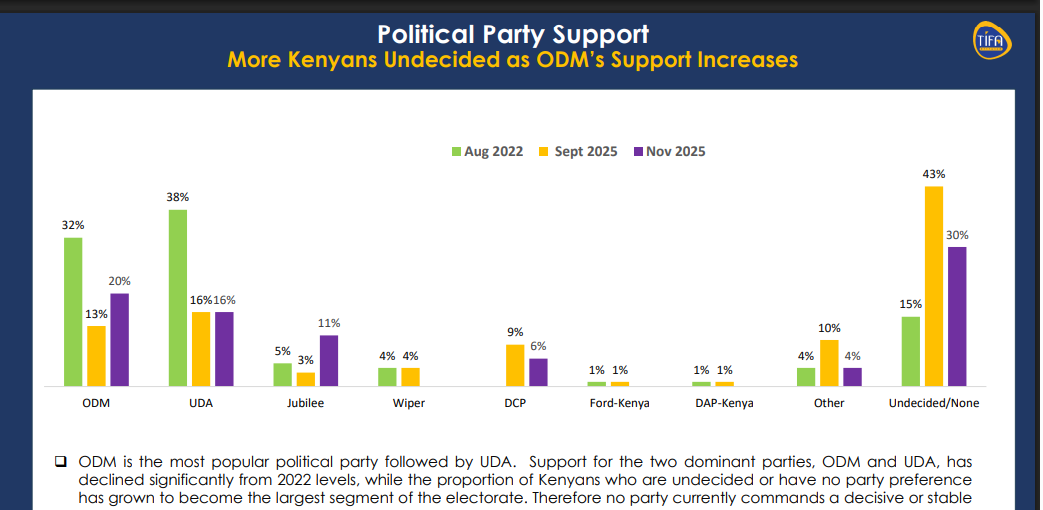
The report explains that support for both ODM and UDA has declined significantly from 2022 levels. At the same time, the number of Kenyans who are undecided or have no party preference has grown to become the largest single group.
TIFA says, “No party currently commands a decisive or stable base.”
Party support and shifting loyalties
TIFA explains that voter loyalty is now fluid, with many Kenyans open to changing political alignment. The survey states that ODM leads with 20% support, while UDA follows closely at 16%. It adds that Jubilee holds 11%, while DCP remains at 6%.

The survey also looks at political coalitions. It shows that Azimio enjoys greater support than Kenya Kwanza at 6% versus 2%. TIFA notes that under the Broad-Based Government, BBG, arrangement, parties and coalitions linked to government make up about 44% of the adult population.
However, TIFA cautions that not all ODM support can be assumed to favour President William Ruto in 2027.
The report points to “increasingly vibrant debate within ODM in the wake of Raila’s passing,” which may affect future voting patterns.
The survey further shows changes among voters with no party preference. TIFA reports that those identifying with no party dropped from 31% to 22%, while the undecided group fell from 10% to 6%. The report says it is unclear whether this change is linked to heightened political activity.
TIFA concludes that Kenya’s political landscape remains open and unpredictable.