Advertisement
Murder in the ward: The security crisis no one talks about in public hospitals
18th July, 2025 04:56 AM

Hospitals are meant to be sanctuaries of healing—a place where pain meets care and recovery begins. But recent events at Kenya’s largest referral hospital, Kenyatta National Hospital (KNH), have shattered that illusion, exposing a disturbing truth: some of our public health institutions are silently becoming crime scenes.
On July 17, 2025, the country was jolted by the brutal murder of Edward Maingi Ndegwa, a patient admitted at KNH’s Ward 7B. He was under treatment, monitored, and surrounded by fellow patients and nurses. Yet, in the middle of the day, in the supposed safety of a public hospital ward, he was killed—his body discovered with blood pooling around his neck.
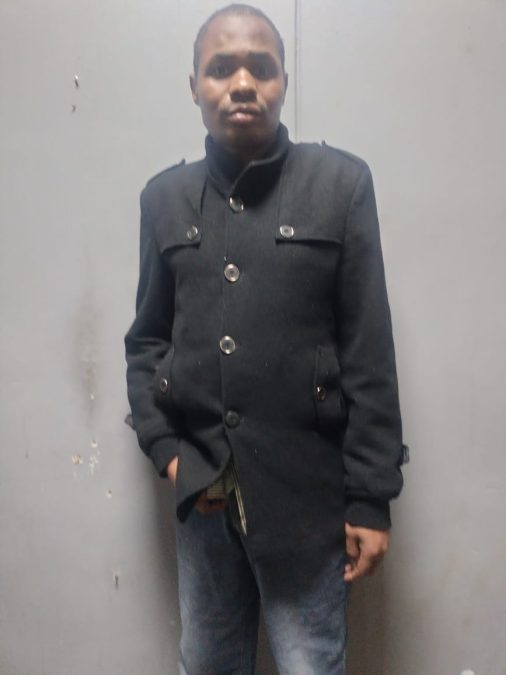
The person of interest, Kennedy Kalombotole, was not an outsider. He was another patient admitted to the hospital since December 2024 and now stands accused not only of Maingi’s murder but also of an eerily similar killing of Gilbert Kinyua Muthoni in Ward 7C back in February 2025.
The case has sparked outrage and horror. But more importantly, it has unearthed a chilling and often ignored crisis: the lack of proper security in Kenya’s public hospitals.
System built to heal, not to protect
Most public hospitals in Kenya, including KNH, operate under intense pressure, overwhelmed by patient numbers, underfunded, and severely understaffed. Their primary focus is clinical care, not criminal prevention. Yet this leaves significant gaps in safety, particularly in high-dependency wards and long-stay units where vulnerable patients spend days or weeks with minimal supervision.
There is little to no security presence within patient wards. Surveillance cameras, if present at all, are not monitored in real time. Psychiatric assessments are not routine for admitted patients unless they present with obvious signs. In such environments, a violent individual—especially one blending in as a patient—can go unnoticed for months.
Missed red flags
Kalombotole’s stay at KNH began on December 1, 2024. Within weeks, the first murder happened in Ward 7C.
According to the Directorate of Criminal Investigations (DCI), a case file was compiled and submitted to the Office of the Director of Public Prosecutions (ODPP), but further investigations were recommended, and the suspect remained within the facility.
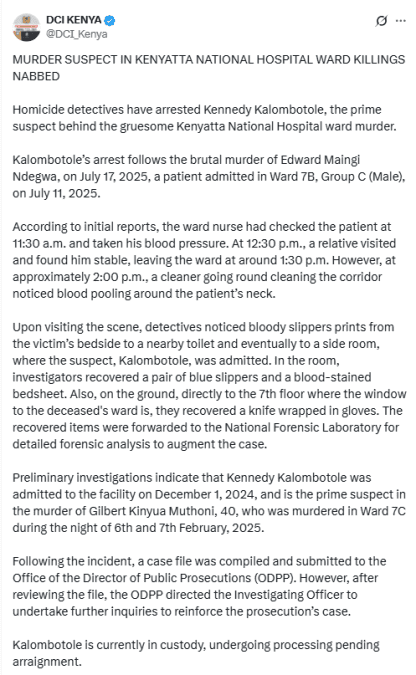
By the time Maingi was murdered in July, Kalombotole had spent over seven months in the hospital, possibly untreated, unmonitored, and dangerous. It wasn’t until a second life was taken that serious action followed.
Why was he still admitted? What measures were taken after the first murder? Were patients and staff warned or protected?
Families and frontline workers at risk
If patients aren’t safe from fellow patients, who is?
Nurses, doctors, cleaners, and carers work around the clock with little backup or protective training.
Rethinking hospital security
These killings must be a turning point. Public hospitals urgently need:
- Surveillance upgrades: Real-time camera monitoring, panic buttons, and controlled ward access.
- Mental health screenings: All patients, especially long-term ones, should undergo psychological evaluation on admission and periodically thereafter.
- Security training for staff: Nurses and attendants must be equipped to spot and report early warning signs of violence.
- Policy reform: The Ministry of Health must treat hospital security as a public safety issue, not just a medical one.
Disclaimer: Views expressed in this article are the writer’s. They do not necessarily reflect the views of K24 Digital or Mediamax Network Limited.