Advertisement
Waihiga Mwaura raises election question as 6 African countries prepare to go to polls
10th August, 2026 11:24 AM

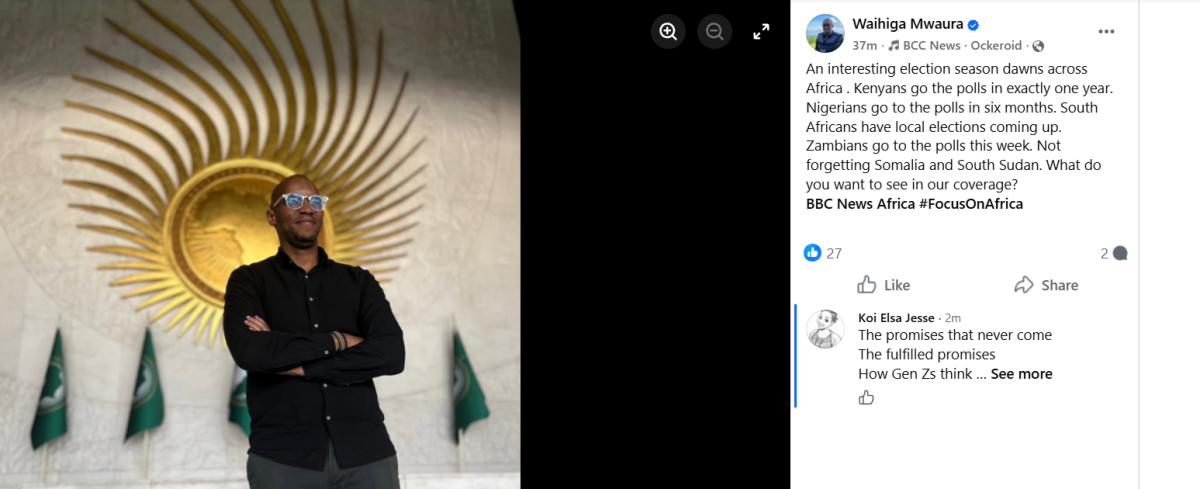
BBC journalist Waihiga Mwaura has highlighted an increasingly busy election season across Africa, naming Kenya, Nigeria, South Africa, Zambia, Somalia and South Sudan among the countries facing major electoral moments in the coming months.
In a Facebook post on Monday August 10, 2026, Mwaura described the period ahead as an interesting election season, noting the different timelines by which voters in the six countries will head to the polls.
“An interesting election season dawns across Africa,” Mwaura wrote.
He noted that Kenya is one year away from its next general election, while Nigeria is six months away from its own national vote.
Mwaura also pointed to South Africa, where local elections are expected, before turning his attention to Zambia, which is set to go to the polls this week.
“Not forgetting Somalia and South Sudan,” he added.
The journalist then asked audiences what they would like to see from election coverage as the different countries move towards their respective electoral moments.
“What do you want to see in our coverage?” Mwaura asked.
Political cycles
The electoral calendar he highlighted brings together countries at very different stages of their political cycles. Zambia is the first among them to face a national vote, with its general election scheduled for August 13, 2026.
More than 8.7 million registered voters are expected to participate in the election, which will determine the country’s president, members of the National Assembly and local councillors. President Hakainde Hichilema is seeking a second term under the United Party for National Development, with opposition figures including Brian Mundubile challenging the incumbent.
The campaign has unfolded against concerns over the cost of living and debate over whether Zambia’s copper wealth is translating into jobs and broader economic opportunities for citizens.
South Sudan is scheduled to follow with its long-awaited general election on December 22, 2026, in what would mark a major moment for a country that has experienced repeated delays to its electoral timetable since gaining independence in 2011.
The vote is expected to involve the presidency, the National Legislative Assembly and the Council of States. President Salva Kiir and opposition leader Riek Machar remain central figures in the country’s political landscape, while authorities continue working to establish the administrative and logistical structures needed for the election. The vote is being closely watched because of the country’s prolonged political transition and the challenges that have repeatedly pushed previous election plans off course.
Nigeria is then scheduled to begin its next general election on January 16, 2027, with voters expected to elect the president, senators and members of the House of Representatives. The presidential contest could proceed to a runoff on February 28 if no candidate satisfies the constitutional requirements for an outright victory.
The Nigerian election will be one of Africa’s most consequential political contests, given the country’s size, population and economic influence, with issues surrounding the economy, security and governance expected to feature prominently in the campaign.
Kenya is also moving steadily towards its August 10, 2027 general election, when voters are expected to elect the president, senators, members of the National Assembly, governors and Members of County Assemblies. The Independent Electoral and Boundaries Commission has already begun preparing for the electoral cycle, with key deadlines set ahead of polling day.
Public officers intending to contest elective positions are required to resign by February 9, 2027, voter registration is scheduled to close on May 13, while the official campaign period is expected to run from May 29 to August 7, 2027.
Kenya’s election timeline has also attracted constitutional debate after a Malindi High Court ruling raised questions over whether the vote should instead be held in 2026, although the effect of the ruling was suspended to prevent disruption and the August 2027 date remains the operative election timetable.
South Africa is also part of the wider electoral picture, although its national election is not due until 2029. The country is scheduled to hold local municipal elections in November 2026, giving voters an opportunity to determine the leadership of their local authorities before the next national general election.
South Africa’s national vote differs from presidential systems such as Kenya and Nigeria because voters elect members of the National Assembly and provincial legislatures, after which the National Assembly chooses the president.
Author
Steve Ireri
Steve is a senior writer with over four years of experience in digital journalism. His focus is on the showbiz and human interest stories. Emails: [email protected] , [email protected]
View all posts by Steve Ireri