Advertisement
TI Kenya: Men more likely to pay bribes than women
31st July, 2025 02:59 PM

Men are more likely to engage in bribery than women, according to a new report by Transparency International Kenya, which paints a detailed picture of how gender and age influence corruption experiences in the country.
In its latest Kenya Bribery Index, dated July 17, 2025, the organisation found that 64 per cent of male respondents reported paying a bribe compared to 36 per cent of women. The survey, which captured data from 15 counties, documented both the frequency of bribe payments and the socio-economic factors that shape interactions with public institutions.
“Across the gender divide, the proportion of male respondents who reported paying for a bribe was much higher at 64% compared to 36% among females,” the report notes.
TI Kenya attributed the disparity to traditional gender roles, which often place men at the centre of economic activities, thus increasing their exposure to corruption-prone spaces such as licensing offices, police stations, and land registries.
“It could be likely that due to gender norms and relations, men are more active economically and therefore likely to interact more with public institutions, eliciting more bribery opportunities,” the report explained.
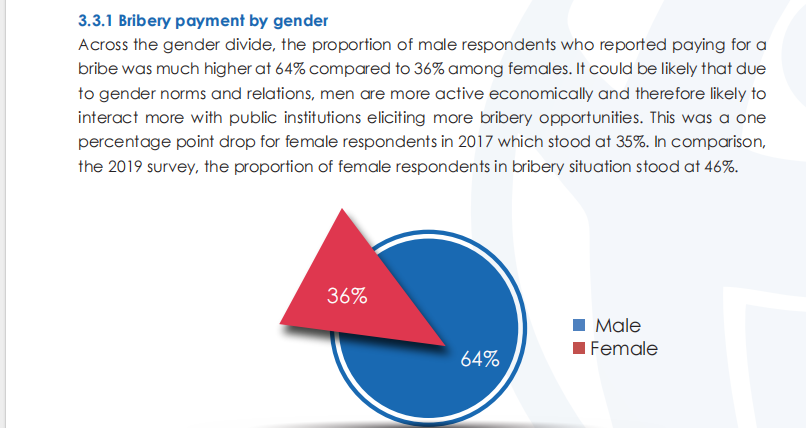
The findings also show minimal change over the years. In 2017, 35 per cent of women reported paying bribes, compared to 36 per cent this year. However, the proportion was significantly higher in 2019, when 46 per cent of female respondents said they had been involved in a bribery situation. This fluctuation, TI said, reflects varying exposure levels depending on economic and political context.
Age also plays a key role. The report identified youth and middle-aged adults as the most vulnerable. The 25–44 age group recorded the highest bribery frequency at 32 per cent, while those aged above 45 reported the lowest levels of engagement in bribery.
“The frequency was lowest among the age group above 45 years, perhaps reflecting the lower participation in social and economic activities in society,” the report read.
The report further observed that younger Kenyans are more likely to interact with key service delivery points, including schools, hospitals, law enforcement agencies, business licensing departments, and motor vehicle registration units, which are hotspots for bribe demands.
Transparency International Kenya said the data should be used to shape anti-corruption policies that address the distinct vulnerabilities faced by different segments of the population. It also called on government institutions to focus reforms on frontline service points where bribery is rampant and reporting mechanisms remain weak.