Advertisement
Senators initiate move to end power struggles with MPs
15th August, 2025 02:57 PM

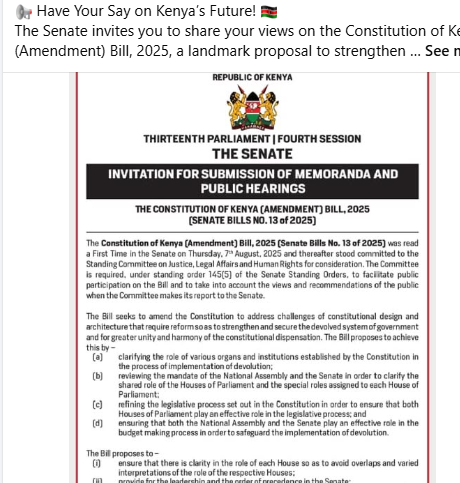
The Senate has officially invited Kenyans to weigh in on far-reaching proposals to amend the Constitution of Kenya, 2010, in what could become one of the most significant governance shake-ups in recent years.
The Constitution of Kenya (Amendment) Bill, 2025, published as Senate Bills No. 13 of 2025, was tabled for the first time on Thursday, August 7, 2025, and committed to the Standing Committee on Justice, Legal Affairs and Human Rights for public participation.
In a public notice on Friday, August 15, 2025, Senate Clerk J.M. Nyegenye explained that the process is designed to facilitate public participation on the Bill and to consider the views and recommendations of the public when the Committee submits its report to the Senate.
“The Bill aims to address long-standing challenges in Kenya’s constitutional design and governance structure, with the Senate stating it is necessary to strengthen and secure the devolved system of government and for greater unity and harmony of the constitutional dispensation,” the notice read.
If enacted, the amendments will clarify the roles of various constitutional organs in implementing devolution, review the mandates of the National Assembly and Senate to clearly define their shared and special roles, refine the legislative process to ensure both Houses of Parliament have an effective voice in lawmaking, and strengthen the budgeting process to safeguard devolution funding.
“Among the 15 major reforms, the Bill proposes to ensure clarity in the role of each House to avoid overlapping interpretations, provide for Senate leadership and order of precedence, and specify where money Bills can originate mostly in the National Assembly, except in special cases,” it reads.
Allocation of funds
It further seeks to mandate the joint involvement of both Houses in allocating and appropriating public funds, to define the Money Bill more precisely, to require the joint submission of passed Bills to the President for assent, and to establish a County Assembly Fund for each county.
“Other key changes include making the County Allocation of Revenue Bill the basis for preparing county budgets, granting both Houses authority over approving or removing certain state officers, and introducing clearer procedures for mediation, presidential assent timelines, and handling national government expenditure estimates,” Nyengenye explained.
If passed, these provisions will significantly alter Kenya’s legislative balance of power, particularly between the Senate and the National Assembly, and could transform how counties receive and manage funds.
“The creation of a County Assembly Fund is expected to give Members of County Assemblies unprecedented financial autonomy, a move likely to reshape local governance and accountability. The clarification of what constitutes a money Bill could also help resolve long-running disputes between the two Houses over budget-related legislation,” the notice reads.
Kenyans are being urged to actively participate in shaping these constitutional changes. Citizens, institutions, and interest groups have until Friday, September 26, 2025, at 5:00 p.m. to submit written memoranda to the Clerk of the Senate.
The Senate has also announced plans to hold public hearings in all 47 counties, with dates to be communicated soon.