Advertisement
Salasya reveals plan to have women and youth get lion’s share of govt tenders
01st September, 2025 02:49 PM

Mumias East MP Peter Salasya has announced plans to introduce a new bill in Parliament this September 2025, seeking to increase procurement opportunities for youth, women, and persons with disabilities (PWDs) from the current 30 per cent to 50 per cent.
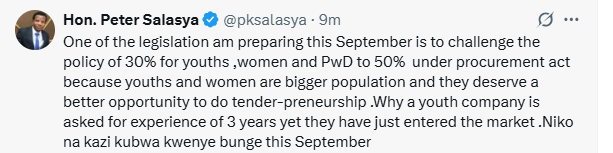
In an X post on Monday, September 1, 2025, Salasya argues that the current policy under the Public Procurement and Asset Disposal Act, which reserves 30 per cent of government tenders for youth, women, and PWDs, is outdated and fails to reflect the demographic realities of Kenya.
“One of the legislations I’m preparing this September is to challenge the policy of 30% for youths, women, and PWDs to 50% under the Procurement Act,” the statement read.
According to the first-time legislator, young people and women make up a significant majority of Kenya’s population and deserve a fairer share of government contracts.
“Youths and women are the bigger population, and they deserve a better opportunity to do tender-preneurship,” he wrote.
Punitive requirements
Salasya also took issue with what he termed as unfair eligibility requirements that block youth-run businesses from accessing public tenders. He questioned the rationale behind demanding years of experience from companies started by young entrepreneurs who are just entering the market.
“Why is a youth company asking for experience of 3 years, yet they have just entered the market?” he posed.
The MP has positioned himself as a vocal advocate for youth empowerment and economic inclusion and says his legislative agenda this session will focus heavily on reforms that uplift young people and marginalised groups.
“Niko na kazi kubwa kwenye Bunge this September,” Salasya added, affirming his commitment to bringing meaningful legislative change.
If passed, it would significantly alter the current procurement framework and potentially unlock billions in tender opportunities for youth-led and women-led enterprises across the country.
Salasya’s push comes at a time when the government is facing pressure to create jobs and stimulate entrepreneurship among the youth, who are grappling with high unemployment rates and limited access to capital.
Civil society organisations have also been advocating for equity and inclusion, arguing that public procurement can be a powerful tool for social justice if implemented fairly and transparently.