Advertisement
Ruto: University students now pay between Ksh5K and Ksh75K in reduced fees
30th September, 2025 06:41 PM
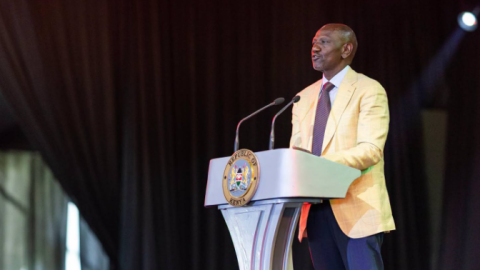
Caption:President William Ruto speaking during commissioning of phase II of UMMA University. VIDEO/K24TV President William Ruto has announced a significant reduction in university fees, saying Kenyan students are now paying between Ksh5,800 and Ksh75,000, depending on their programme of study and level of need.
Speaking at UMMA University on Tuesday, September 30, 2025, the Head of State stated that the new university funding model has transformed higher education by ensuring that scholarships and loans are awarded fairly based on students’ financial ability.
Also watch: Ruto pushes e-procurement plan despite resistance
“University fees have been reduced significantly. Students now pay between Ksh5,800 and Ksh75,000 depending on their ability and program of study,” he said.
“The student-centred funding model is a game-changer for higher education. Scholarships and loans are now awarded on the basis of need, ensuring fairness and equal opportunity for all Kenyan learners,” Ruto added.
The new system classifies students into four categories: vulnerable, extremely needy, needy, and less needy, with government support tailored accordingly.
Vulnerable students receive full scholarships, while others benefit from a mix of scholarships and affordable loans.
Auditor-General’s report
This comes months after the Office of the Auditor General (OAG) raised critical concerns about the New Funding Model (NFM) for higher education, which was recently declared unconstitutional by the High Court.
According to the Auditor-General’s report on National Government Ministries, Departments and Agencies for the Financial Year 2023/2024, the funding model, which adopted a student-centred funding approach using a Means Testing Instrument (MTI) to categorise learners into five financial bands, encountered eight critical issues during its implementation.
Among the issues highlighted in the report are inaccurate data submissions by applicants and limited public awareness of the model.
“Inaccurate data submission by applicants led to distorted MTI scores…limited public awareness led to information gaps for intended beneficiaries,” part of the report reads.
The Auditor General also pointed out that delays in the disbursement of loans and scholarships made higher education less accessible for many learners.
“Delayed funds disbursements in the form of loans and scholarships that disrupted students’ ability to pay tuition fees, access accommodation and cover living expenses,” the report added.
Also watch: HELB CEO defends listing of defaulters, says genuine hardship cases won’t be affected
Furthermore, the report raised concerns about inclusivity, mentioning that vulnerable groups, such as students with disabilities and those from marginalised regions, faced challenges in securing adequate financial support.
In particular, it noted that Muslim students needing Sharia-compliant financial products struggled under the new system, which further hindered inclusivity.
“Inclusivity concerns where vulnerable groups, such as students with disabilities or those from marginalised regions, faced difficulties accessing the funds they need; emerging concerns on unique challenges, such as those faced by Muslim students who require sharia-compliant financial products, further hindered inclusivity,” the report added.
Another significant concern is the loan repayment burden caused by high unemployment and underemployment rates.
The report warns that many graduates are struggling to repay their loans, which is increasing default rates and threatening the sustainability of the revolving fund.
“High unemployment and underemployment rates made it challenging for graduates to repay their loans, increasing default rates and threatening the sustainability of the revolving fund,” the report stated.