Advertisement
National Assembly approves Senate amendments to Land Bill
13th August, 2025 04:13 PM
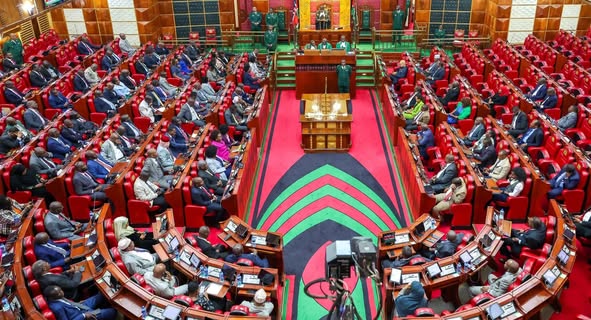
The National Assembly has approved Senate amendments to the Land (Amendment) Bill, introducing new measures to enhance transparency in public land transactions.
The changes require the Registrar to publish a gazette notice specifying the particulars of land registration involving public land before finalising the registration process, ensuring that critical information is available to the public.
According to a post shared by the National Assembly on X on Wednesday, August 13, 2025, the bill, sponsored by MP Simon King’ara, was first passed by the National Assembly on March 20, 2024, before being referred to the Senate for consideration.
“The Bill, sponsored by Hon. Simon King’ara, MP, was first passed by the National Assembly on 20th March 2024 before being referred to the Senate for consideration, as it is a Bill concerning counties. On 15th April 2025, the Senate passed the Bill with an amendment to Clause 3, which the National Assembly approved on 14th May 2025,” the NA wrote.
Under the amended Clause 5, the Registrar must publish a notice in the Gazette outlining the registration particulars in cases covered under the proposed sub-section (16).
“The amendment to Clause 5 of the Bill will require that the Registrar publish a notice in the Gazette specifying the particulars of the registration in cases covered under the proposed sub-section (16). This gazette notice will be issued before the finalisation of the registration process, ensuring public access to critical information on land transactions.”
The approval of these amendments comes a day after Parliament passed the National Land Commission (Amendment) Bill, 2023, for the second time, restoring the Commission’s mandate to review historical land allocations and address related injustices.
Parliament had announced that the legislation accommodates President William Ruto’s reservations and establishes a five-year window for the Commission to review grants and dispositions of public land issued before August 27, 2010.
“The amendment restores the Commission’s mandate to review historical land allocations and address injustices, while introducing safeguards and time limits,” Parliament stated in a release on August 12, 2025.
Under the amendments, the National Land Commission (NLC) can petition Parliament for an extension beyond the five years, with all determinations to be published in the Kenya Gazette and potentially registered in the High Court.
During the parliamentary debate, Lands Committee Chair Joshua Nyamoko described the changes as providing operational clarity for the Commission.
“There was nothing major, including Clause Two on the five-year limit. We can still revisit and see whether we are able to give that extension,” Nyamoko told the House.
Deputy Majority Leader Owen Baya welcomed the reforms, highlighting their role in reviving stalled land reviews affecting regions such as the Coast, Western, Nyanza, Nairobi, and Northern Kenya.
“Let the people who have long suffered historical land injustices now get justice because we have given them the law and the power to do it,” he said.
MP Johana Ng’eno of Emurua Dikirr framed the debate in historical terms, linking the land reforms to Kenya’s independence struggle.
“We fought for independence to get economic independence, political independence, and to get back our lands. Some regions only got political independence but have been denied economic independence and their land,” he stated.
However, concerns were raised about the potential implications of the amendments for property rights, the economy, and the banking sector.
Mathare MP Anthony Oluoch cautioned that those holding property titles, especially freehold, should be aware of the impact on collateral and legal certainty.
“The sunset clause was introduced so there can be certainty of legal titles as a function of the economy. Equity only assists the vigilant and not the indolent,” he noted.
Author
Steve Ireri
Steve is a senior writer with over four years of experience in digital journalism. His focus is on the showbiz and human interest stories. Emails: [email protected] , [email protected]
View all posts by Steve Ireri