Advertisement
LSK urge Great Lakes states to prioritise justice for the marginalised
22nd July, 2025 02:29 PM

The Law Society of Kenya (LSK) has urged countries in the Great Lakes Region to prioritise justice for marginalised communities, warning that legal systems across the region are failing the most vulnerable.
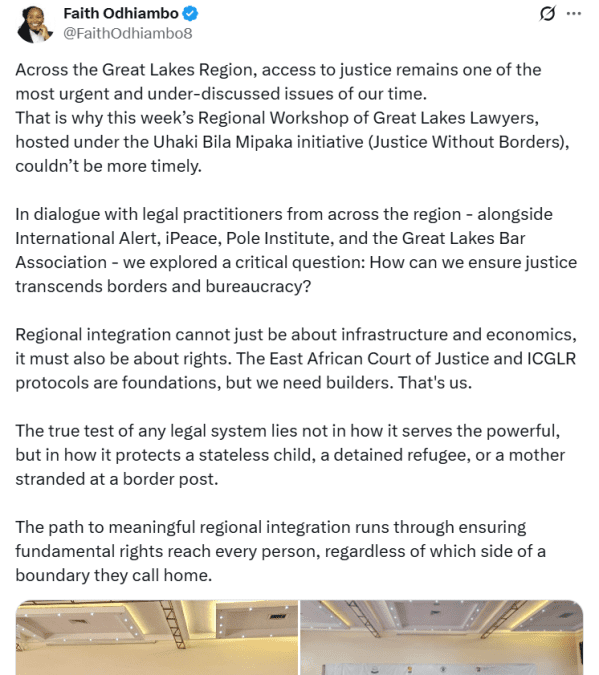
Speaking during the Regional Workshop of Great Lakes Lawyers in Nairobi on July 22, 2025, LSK President Faith Odhiambo described access to justice as “one of the most urgent and under-discussed issues of our time.”
The workshop, held under the Uhaki Bila Mipaka (Justice Without Borders) initiative, brought together legal practitioners and regional partners, including International Alert, iPeace, Pole Institute, and the Great Lakes Bar Association.
Odhiambo said the meeting offered a vital platform to rethink how justice can transcend borders and bureaucratic hurdles, especially for those who often fall through the cracks of legal systems. Her remarks echoed findings from a 2021 World Bank report that revealed only 20 percent of citizens in the Great Lakes Region have access to reliable legal recourse.
She challenged the traditional notion of regional integration, saying it should go beyond trade and infrastructure. “Regional integration cannot just be about roads and economics. It must also be about rights,” she said.
Role of regional courts
Odhiambo pointed to the East African Court of Justice and the International Conference on the Great Lakes Region (ICGLR) protocols as tools that can support the realisation of justice across borders.
However, she cautioned that these institutions are only as effective as their implementation on the ground.
A 2019 study published in the Journal of African Law supports this perspective, showing that robust regional judicial frameworks can reduce conflict by up to 15 per cent—challenging the idea that economic development alone guarantees peace and stability.
Odhiambo’s speech also touched on the plight of refugees, stateless children, and women trapped at border crossings. Citing a 2023 UNHCR report that found 70 percent of refugees in the region face legal barriers, she said justice systems must be measured by how well they protect those who have no one else to turn to.
“The true test of any legal system lies not in how it serves the powerful, but in how it protects a stateless child, a detained refugee, or a mother stranded at a border post,” she said.
As discussions at the workshop continue, the LSK’s leadership is setting the tone for a wider conversation on how the region can make justice a universal right, not a privilege.