Advertisement
4 in 10 Kenyans acknowledge existence of ethnic leader – TIFA
24th September, 2025 12:25 PM

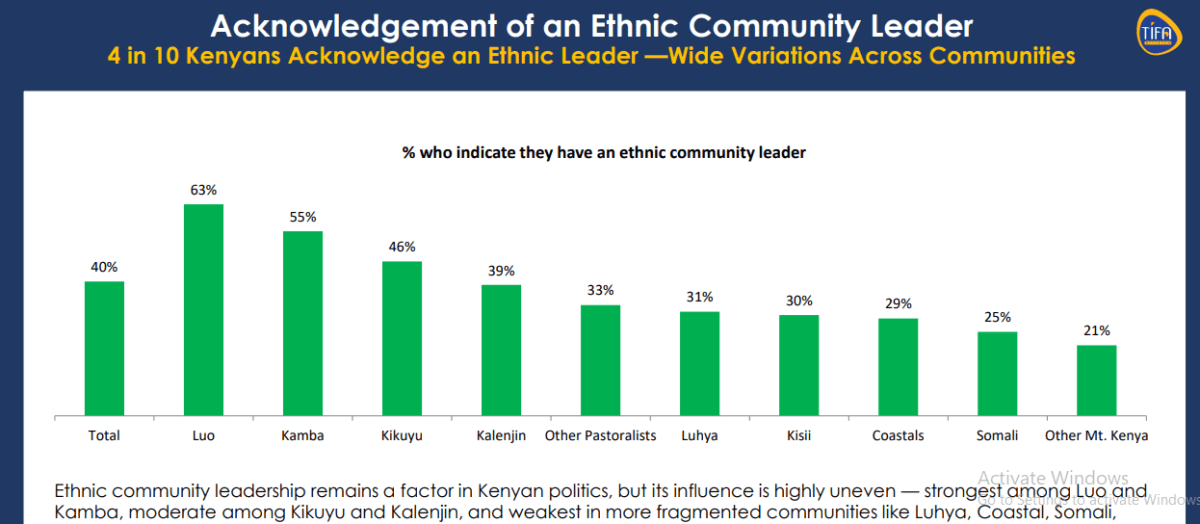
Only four in ten Kenyans say their ethnic community has a recognised leader who provides guidance on political and public issues, according to a recent survey by TIFA Research.
The findings highlight wide variations in ethnic leadership influence across the country.
The survey, which sampled a cross-section of Kenya’s major ethnic groups, shows that recognition of community leaders is strongest among the Luo (63%) and Kamba (55%), moderate among Kikuyu (46%) and Kalenjin (39%), and weakest in other pastoralist groups, Luhya, Kisii, Coastal communities, Somali, and other Mt Kenya East groups, with figures ranging from 33% down to 21%.
TIFA’s report notes that while analysts often portray Kenyans as heavily influenced by their ethnic leaders, this is not entirely accurate.
“Not even a majority acknowledge that their community has a leader,” the report says, pointing out that only the Luo and Kamba recorded majority recognition.
Ethnic influence varies
The findings suggest that in the upcoming 2027 elections, political mobilisation may rely on strong ethnic anchors among Luo, Kamba, Kikuyu, and Kalenjin communities, where leaders still hold sway.
In contrast, fragmented communities such as Luhya, Coastal, Somali, and other Mt Kenya East groups may see weaker consolidation of support under a single figure.
“Whether the perception of ethnic-based community leadership or its absence contributes positively or negatively to Kenya’s social, economic, and political development remains a separate question,” the TIFA report adds.
The survey asked respondents, “Would you say that your ethnic community has a particular leader that most people look to for information and guidance about political and other public issues?” with options for Yes, No, and Not Sure.
The Luhya region, for example, has experienced split backing between government and opposition leaders. Speaker Moses Wetangula and Prime CS Musalia Mudavadi are aligned with the government, while Trans-Nzoia Governor George Natembeya and Eugene Wamalwa of the Democratic Party of Kenya remain in opposition, reflecting the complexity of local political dynamics.
Meanwhile, in Kisii, the “kingpin” leadership seat has remained widely open for years, influenced by factors including former CS Fred Matiangi and retired Chief Justice Maraga, yet no single leader has emerged as a dominant figure.
Author
William Muthama
William Muthama is a digital journalist with a focus on entertainment, human interest, and current affairs. Share stories: [email protected]/ [email protected]
View all posts by William Muthama