Advertisement
Dear Safaricom, M-Pesa messages showing account balance put Kenyans at risk
17th November, 2025 01:18 PM

M-Pesa is a mobile money service that started in Kenya in 2007 to allow people to send and receive money, pay bills, and manage their finances directly from their mobile phones. It is used by millions of Kenyans every day for personal and business transactions.
Despite its ubiquity, there is a vulnerability in the system that puts ordinary users at avoidable risk. Every payment confirmation message not only verifies the transaction but also reveals the user’s remaining balance.
This small detail has had serious consequences for people who are asked to show the message to traders, matatu touts, or others as proof of payment.
Many traders and touts insist on seeing the M-Pesa message as verification, yet they also gain a window into the user’s account balance.
There have been numerous reports of individuals being robbed immediately after sharing their confirmation messages.
The practice of requiring people to expose their balances as proof of payment has created a perfect opportunity for criminals to identify targets.
In crowded matatu stages, busy markets, and even on quiet streets, a simple text message has become a source of danger for unsuspecting Kenyans.
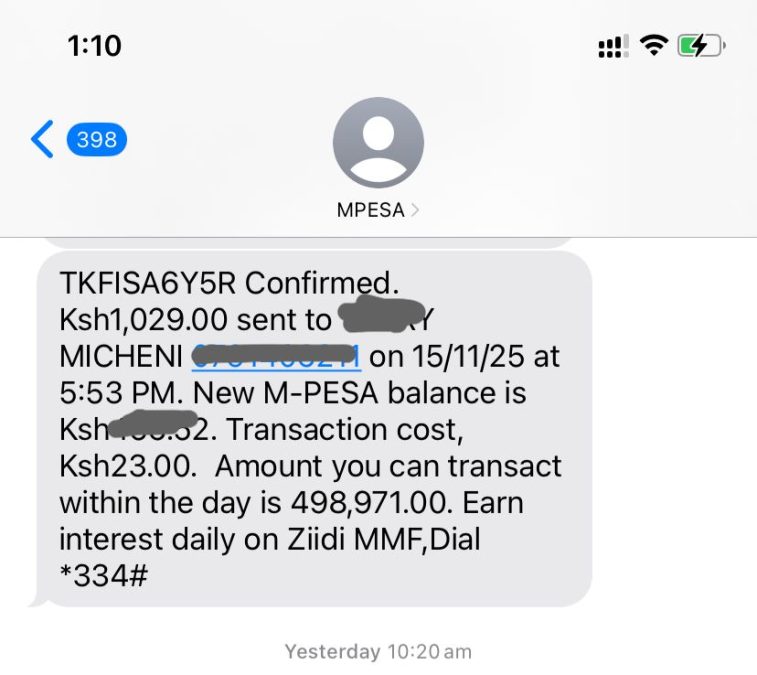
Users are left in a dilemma because refusing to show a confirmation message can disrupt a transaction or provoke conflict.
Yet showing it comes at a risk that should not exist in a secure financial system.
This situation reveals a gap in privacy and protection that has long been ignored and that must be addressed urgently. Financial transactions are meant to be private, and users should be able to prove a payment without exposing their balance to anyone else.
Public pressure around this issue grew louder on Sunday, November 16, 2025, after ODM Communications Director Philip Etale raised the alarm.
He posted a concern to Safaricom on social media, saying it was unfair for customers to be forced to expose their balance whenever they make a payment.
He urged the company to adopt a QR-style payment system similar to WeChat, where customers scan and pay without disclosing personal financial details.
His statement resonated widely because it captured what millions silently feel. People want convenience but not at the cost of their dignity or safety.
“Dear @Safaricom_Care, it is unfair and annoying for someone to look at your M-Pesa balance in the name of checking the transaction message after making payments. Why don’t you guys invent something like @Weixin_WeChat, where you just scan and pay directly? Think about this,” he wrote.
Safaricom responded to the post, saying it had taken the concern as feedback.
The acknowledgement was welcome, but Kenyans would more likely appreciate visible action.
They want technology that protects them.
They want the company to build payment channels that do not turn their phones into open financial files.
Disclaimer: The views and opinions expressed in this article are solely those of the writer and do not reflect the position or views of K24 Digital or Mediamax Network Limited.
Author
Steve Ireri
Steve is a senior writer with over four years of experience in digital journalism. His focus is on the showbiz and human interest stories. Emails: [email protected] , [email protected]
View all posts by Steve Ireri