Advertisement
Willis Otieno faults Ruto for Kenya’s mounting fiscal crisis
02nd August, 2025 07:04 AM

As Kenya faces an escalating fiscal crisis, political analyst Willis Evans Otieno has squarely blamed President William Ruto, accusing him of engineering the country’s economic turmoil during his tenure as deputy president under the Jubilee administration.
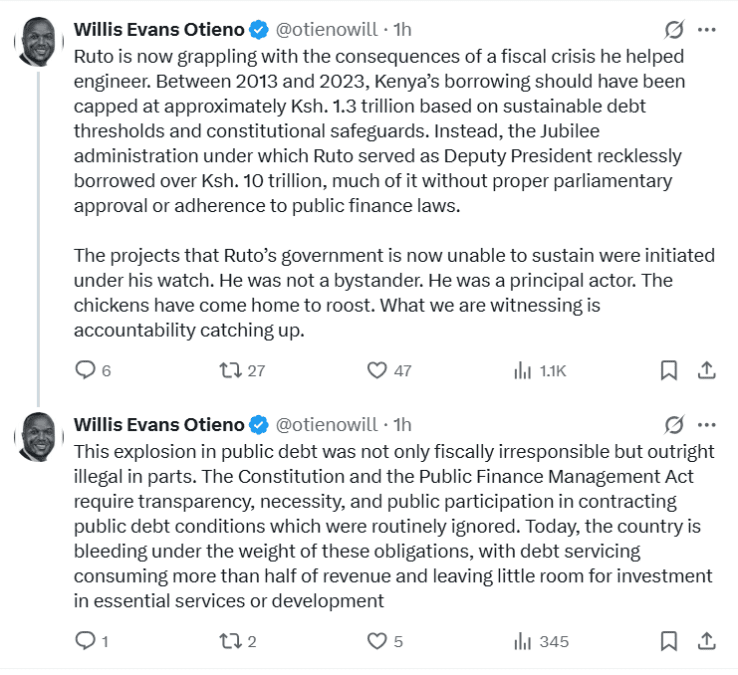
In a scathing post on X dated August 2, 2025, Otieno argued that the country’s economic woes stem from unsustainable borrowing between 2013 and 2023.
“Ruto is now grappling with the consequences of a fiscal crisis he helped engineer. Between 2013 and 2023, Kenya’s borrowing should have been capped at approximately Ksh1.3 trillion based on sustainable debt thresholds and constitutional safeguards,” Otieno said.
“Instead, the Jubilee administration under which Ruto served as Deputy President recklessly borrowed over Ksh10 trillion, much of it without proper parliamentary approval or adherence to public finance laws.”
Otieno further argued that many of the projects the current administration is now unable to sustain were conceived during Ruto’s time as deputy president, insisting that he was not a bystander but a principal actor.
Public finance laws flouted
In a follow-up post, Otieno described the borrowing spree as “not only fiscally irresponsible but outright illegal in parts.” He cited breaches of the Constitution and the Public Finance Management Act, which mandate transparency, necessity, and public participation in the debt contracting process.
“Today, the country is bleeding under the weight of these obligations, with debt servicing consuming more than half of revenue and leaving little room for investment in essential services or development,” Otieno wrote.
His remarks echo recent data showing Kenya’s debt-to-GDP ratio had climbed to 69.6% by June 2024, according to Cytonn Investments. Debt repayments continue to weigh heavily on the exchequer, leaving ministries grappling with budget shortfalls across key sectors.
Free education at risk
The crisis has hit the education sector hard, with lawmakers warning of the potential collapse of the free education program. On July 25, Kakamega Senator Boni Khalwale urged Parliament to safeguard the legacy of free primary and secondary education championed by the late President Mwai Kibaki.
“If ever there was a time the nation needed Parliament, it is NOW. The great transformational dream and legacy of President Mwai Kibaki of free primary & secondary education must be protected at all costs,” he posted.
This came a day after Education CS Migos Ogamba and Treasury CS John Mbadi appeared before Parliament’s Education Committee, where Mbadi admitted that the government could no longer fully fund the program. “Let us not live a lie. The truth is we don’t have the money to continue funding free education,” he said.
Fiscal reforms
Funding gaps remain stark. Secondary schools currently receive Ksh16,900 per student against a requirement of Ksh22,244, while junior secondary schools get Ksh10,000 instead of Ksh15,042.
Luanda MP Dick Maungu flagged alleged corruption, citing Ksh50 million paid to ghost schools. Meanwhile, Kiharu MP Ndindi Nyoro linked high fuel prices—currently at Ksh186 per litre—to over-taxation, calling for policy reforms to ease the burden on Kenyans.
As the crisis deepens, Otieno’s remarks have added to a growing public demand for transparency and accountability in government spending.