Advertisement
Raila’s failed presidential ambition: How ODM leader came close to power but lost
15th October, 2025 12:49 PM

The ODM leader, Raila Odinga, has died aged 80 without clinching his presidential ambition despite his robust political pedigree and career in both government and opposition.
In the five contests in which he was involved, the late former Prime Minister campaigned on his long-standing principle of unity and change.
In August 2022, Raila made what many believed was his final attempt at the presidency. Backed by former President Uhuru Kenyatta, supported by a strong coalition, Azimio la Umoja-One Kenya, and with seasoned politician Martha Karua as his running mate, Odinga’s fifth stab at the presidency looked promising.
His ten-point manifesto focused on universal healthcare, job creation, and social protection. Many believed this was his moment.
The veteran politicians lost to William Ruto, the United Democratic Alliance (UDA) candidate, who won with 50+1 per cent of the vote.
He challenged the result in the Supreme Court, claiming irregularities in vote tallying. However, the court dismissed his petition, declaring Ruto the validly elected president.
Yet this was not his first heartbreak at the ballot.

Also watch: Miguna Miguna’s take on Raila’s presidency.
2017 Maraga‘s verdict
In 2017, Odinga ran under the National Super Alliance (NASA) against President Uhuru Kenyatta. He accused the Independent Electoral and Boundaries Commission (IEBC) system of having been hacked and results manipulated.
When the IEBC declared Uhuru the winner with over 8 million votes against Raila’s 6.7 million, Raila rejected the results and filed a petition. In a historic decision, the Supreme Court Chief Justice David Maraga annulled the election, the first such ruling in Africa.
However, Odinga withdrew from the repeat poll, citing a lack of reforms. The IEBC proceeded with the election, and Uhuru won a second term amid low voter turnout.
In January 2018, Odinga declared himself the People’s President in a symbolic swearing-in ceremony.
A month later, he reconciled with President Kenyatta in the famous handshake that redefined Kenyan politics.
2013 contest and Supreme Court battle
In 2013, Odinga contested the presidency under the Coalition for Reforms and Democracy (CORD), with Kalonzo Musyoka as his running mate. His main rival was Uhuru Kenyatta, who, along with William Ruto, faced charges at the International Criminal Court for the 2007 post-election violence.
Odinga secured 43.7 per cent of the vote, while Uhuru crossed the 50 per cent threshold, avoiding a run-off.
Odinga claimed the electronic voter system had failed and that manual tallying was compromised. He took the matter to the Supreme Court, but the judges dismissed his petition.
He refused to attend Uhuru’s swearing-in, and soon after, his term as Kenya’s Prime Minister, a position created in the 2008 power-sharing deal, came to an end.
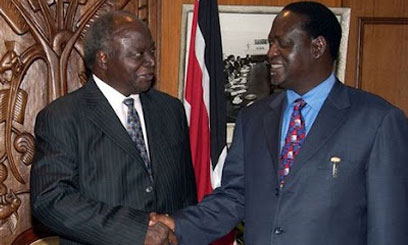
2007: Power-sharing deal
The 2007 election was the closest Raila came to power. Running under the Orange Democratic Movement (ODM), he faced off against incumbent President Mwai Kibaki. Raila accused the government of manipulating the voter registration process and gerrymandering new constituencies to favour Kibaki.
When the Electoral Commission declared Kibaki the winner, Raila and ODM leaders called for mass action. The country plunged into chaos. Over 1,000 people died, and around 250,000 were displaced.
After two months of unrest, a power-sharing agreement was brokered by former UN Secretary-General Kofi Annan. A new position, Prime Minister, was created, and Raila was sworn in on April 17, 2008.
While he had executive power, he was not the head of state. His push for reforms, including a new constitution, laid the groundwork for later elections, but the presidency remained elusive.
1997: The first attempt
Raila’s first presidential run came in 1997 under the National Development Party (NDP). He faced off against strong opposition from then-President Daniel Arap Moi and the Democratic Party’s Mwai Kibaki.
In a fragmented opposition landscape, Odinga came third. Moi retained power, and the vote highlighted the need for opposition unity, a lesson that shaped Raila’s later strategies.