Advertisement
Kenya allocates land to Lusaka Agreement Task Force to construct HQ
20th August, 2025 02:45 PM

The government has allocated land in Nairobi to the Lusaka Agreement Task Force (LATF) for the construction of its permanent headquarters.
According to the Tourism Cabinet Secretary (CS), Rebecca Miano, the allocation will enhance the regional collaboration on wildlife protection and environmental security.
Speaking during the Digital Public Infrastructure (DPI) and Regional Command and Control Centres side event at TICAD 9 in Yokohama, Japan, on August 20, 2025, Miano stated that the new LATF headquarters will host both the Regional Command and Control Centre and the Digital Public Infrastructure.
Additionally, she revealed that it serves as a continental hub for intelligence sharing, joint operations, and early warning systems.
Furthermore, she stated that the infrastructure will play a pivotal role in addressing the growing complexity of human–nature conflicts, wildlife crime, and cross-border conservation challenges.
“This allocation is a tangible demonstration of Kenya’s commitment, for it reflects our dedication to regional cooperation and this important initiative,” she stated.
Miano underscored the growing pressures facing African communities, including habitat loss, climate shocks, and resource competition. Human-wildlife conflict, cross-border poaching, and wildlife trafficking remain persistent threats that no single nation can combat alone.
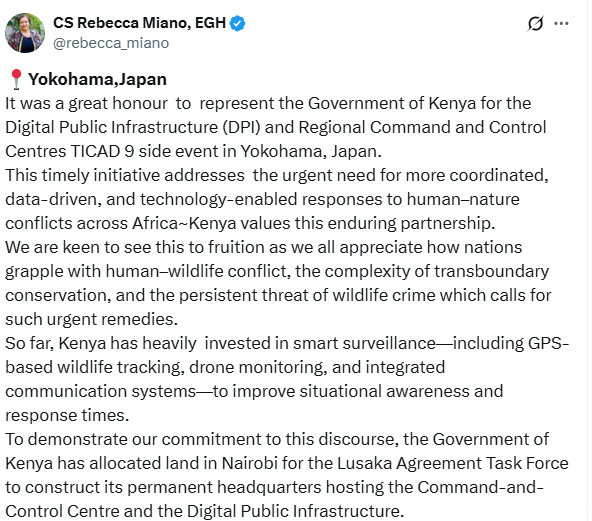
“The Regional Command and Control Centre will be a critical lynchpin in our continental information hub,” she noted. “It will enable joint operations, intelligence sharing, and the signalling of early warnings. This is markedly significant in countering human-nature conflict and cross-border environmental crimes.”
National Command and Control Centre
Kenya has already embraced digital transformation in conservation, deploying tools such as GPS wildlife tracking, drone monitoring, and digitised human-wildlife conflict reporting.
The country’s National Command and Control Centre integrates data from conservancies, protected areas, and enforcement agencies, enhancing early warning and rapid response capabilities.
“Our national strategy aligns perfectly with the regional infrastructure LATF is developing,” Miano said, adding that Kenya views technology-driven solutions as “vitally critical” in safeguarding Africa’s biodiversity.
She highlighted the success of the Wildlife Enforcement Monitoring System, developed in collaboration with LATF, as proof that digital platforms can close enforcement gaps and strengthen cross-border cooperation.
Miano stressed that Africa’s DPI must serve not only governments and agencies but also local communities, ensuring participation and fair benefit-sharing from natural resources.
“DPI must foster inclusivity and brotherhood in a space of shared interests. It must enable community participation and ensure that nature’s treasure trove benefits all.”
Miano linked the initiative to the African Union Digital Transformation Strategy and Kenya’s Digital Superhighway agenda, spearheaded by President William Ruto, which seeks to drive innovation, inclusive growth, and environmental resilience through digital infrastructure.
“Together, we can co-create a prosperous future. Kenya stands ready to work hand in hand with our neighbours, regional institutions, and global partners to realise this grand vision,” she said.