Advertisement
CJ Koome: Petty offenders serving under 3 months should not be in jail
03rd September, 2025 02:53 PM
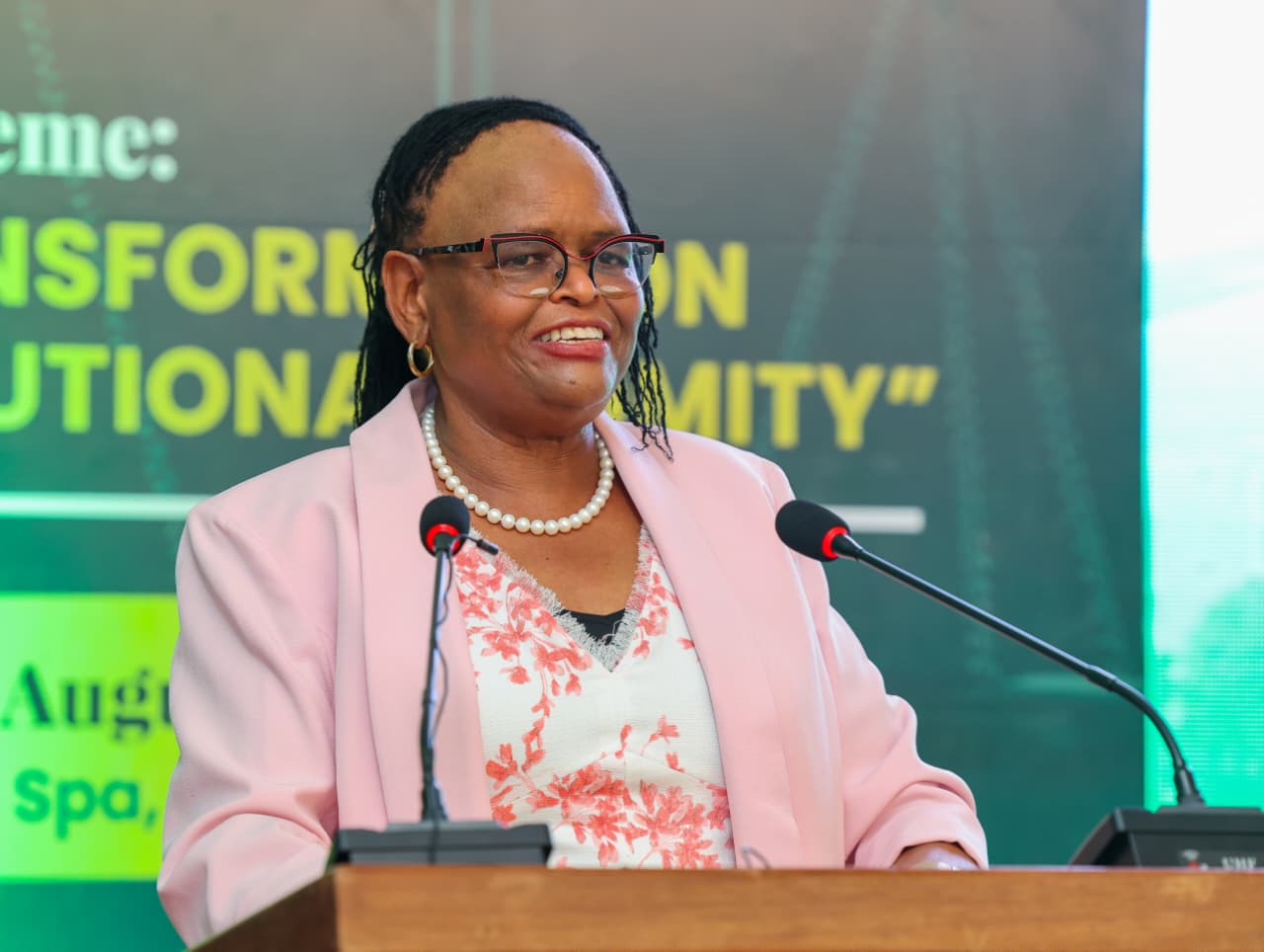
Chief Justice Martha Koome has said petty offenders serving prison terms of less than three months should not be subjected to imprisonment.
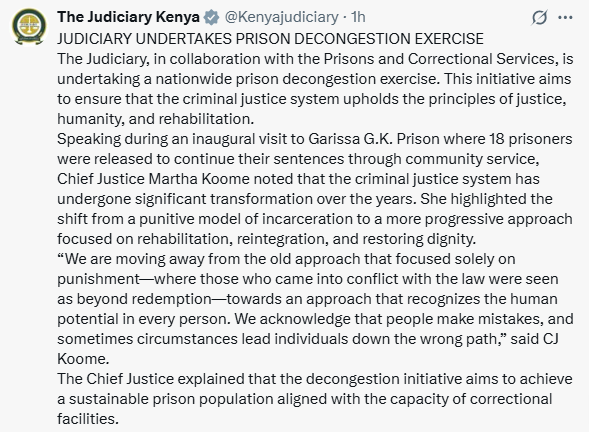
Speaking during her inaugural visit to Garissa G.K. Prison, where 18 inmates were released to continue their sentences through Community Service Orders (CSOs) on Wednesday, September 3, 2025, she stated that the offenders should instead be placed under community service or alternative sentencing.
“The judiciary is committed to reviewing sentences and, where appropriate, releasing convicts of petty and minor offences to perform community service instead of serving time in incarceration,” the Chief Justice said.
Furthermore, the CJ stated that the Judiciary, in collaboration with Prisons and Correctional Services, is implementing a nationwide prison decongestion exercise to restore dignity, enhance rehabilitation, and align prison populations with available capacity.
“We are moving away from the old approach that focused solely on punishment—where those who came into conflict with the law were seen as beyond redemption—towards an approach that recognises the human potential in every person,” CJ Koome said.
She noted that overcrowded prisons undermine rehabilitation and create inhumane conditions, stressing that minor offenders should instead be given a chance to make positive contributions to society.
“Congestion severely undermines the prison’s ability to fulfil its core function—rehabilitation and the reformation of offenders. Overcrowded prisons are not conducive to humane living conditions, and without such conditions, the dignity of those incarcerated is compromised,” she said.
She also assured that children in conflict with the law would be diverted to rehabilitative programs.
“Children belong in schools, not prisons. We must provide rehabilitative avenues that allow them to grow into law-abiding citizens,” she said.
Virtual hearings
On his part, Garissa Presiding Judge John Onyiego said regular prison visits and the use of virtual hearings have sped up case resolutions and eased congestion.
Chief Registrar of the Judiciary Winfridah Mokaya added that reforms such as bail and bond guidelines, expansion of CSOs, and collaboration under the NCAJ are helping reduce overcrowding.
The judiciary said the reforms are part of a long-term shift from punishment to rehabilitation and reintegration.