World Cup: FIFA addresses claims of overhead wire interference in England’s goal against Norway
By Joel Masibo, July 12, 2026FIFA has clarified that England’s goal just before halftime in its World Cup quarterfinal against Norway on Sunday, July 12, 2026, was not affected by contact with the stadium’s overhead wire.
In a statement issued by FIFA Media, the governing body said data from the Connected Ball technology showed no evidence that the ball touched the cable before the goal was scored in the 45+2 minute.

“Before England’s goal in minute 45+2 against Norway, the sensor in the Connected Ball showed no peak in the ‘heartbeat of the ball’ when in the air, and therefore no evidence that the ball touched the overhead wire and changed the movement of the ball,” FIFA said.
Connected Ball technology
The Connected Ball technology uses an internal sensor to monitor ball movement and detect contact, providing officials with additional data to support key decisions during matches.
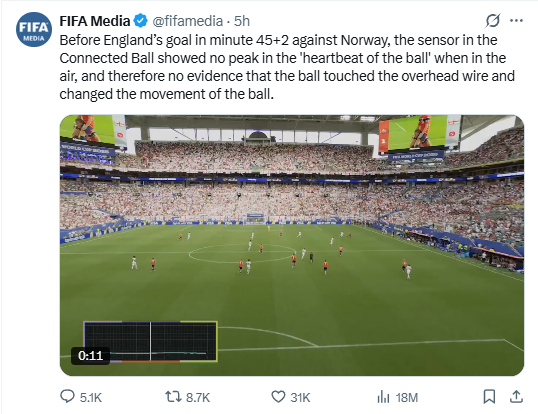
FIFA’s explanation comes after questions were raised over whether the ball had struck the overhead wire before England found the net. The governing body’s review concluded that the sensor detected no impact capable of altering the ball’s flight, confirming the goal stood correctly under the Laws of the Game.
Trionda match ball technology
Recently, FIFA also explained why Croatia’s goal against Portugal was correctly ruled out for offside in the Round of 32 tie played on Friday, July 3, 2026, with the decision backed by the latest Connected Ball Technology integrated into the official Adidas Trionda match ball used at the FIFA World Cup 2026.
According to data generated by the technology embedded inside the adidas Trionda, Croatia forward Igor Matanović (#20) made contact with the ball during the attacking move that led to the goal. That touch proved crucial, as it confirmed the offside phase of play and enabled the match officials to correctly disallow the goal.
The system relies on an Inertial Measurement Unit (IMU) sensor located inside the ball, which is capable of detecting even the slightest contact made by a player. The sensor transmits precise data in real time, providing match officials with additional evidence to support key decisions.
For television viewers, the technology is visualised through a distinctive “heartbeat graphic,” which appears during replays to indicate the exact moment the ball is touched. This helps fans better understand the sequence of events behind offside calls and other critical decisions.