Advertisement
Viking row: Norway’s synchronised wave comes alive ahead of Brazil showdown
05th July, 2026 01:06 PM

Norway’s remarkable run at the 2026 FIFA World Cup has been accompanied by a unique fan tradition that has quickly become one of the tournament’s standout spectacles.
The now-famous “Viking Row” has energised stadiums across North America while adding even more excitement to the country’s long-awaited return to football’s biggest stage alongside stars like Erling Haaland and Martin Ødegaard.
At every Norwegian match, thousands of supporters move in perfect harmony by sitting down together and imitating Viking rowing motions while loudly shouting “Ro!”. The synchronised display has rapidly gained worldwide attention, filling social media feeds and entertaining football fans across the globe as Norway prepares to face Brazil in the last 16 on Sunday, July 5, 2026.
The celebration has spread far beyond stadiums. It has appeared in places such as elevators in Boston, New York’s Times Square, a New York Mets baseball game, and even inside Norway’s Parliament. Norway’s players, led by captain Martin Odegaard, have also embraced the tradition, making it a powerful symbol of the nation’s first World Cup appearance since 1998.
Long-lasting tradition
Although the performance looks like a tradition that has existed for generations, its origins are surprisingly recent.

The movement began in December 2025, when Ole Froystad, affectionately nicknamed “Mr Row Row,” created a chant inspired by Viking rowing culture.
“It’s so much fun to see people come together and row as one. It creates a real sense of unity,” he recently told Inside FIFA. “The Viking Row has become far bigger than I ever imagined. It’s absolutely crazy.”
His concept was later adopted by Norway’s official supporters’ association, which helped turn it into the organised spectacle now recognised around the world.
“It all started with Ole’s idea,” explained Torstein Hamran, a board member of supporters’ club Oljeberget Supporterklubb. “Then we developed it together. We even recorded a song called Viking Blood, which was released at the end of March and features the Viking Row in the background. Today it’s one of the biggest songs in Norway.”
The supporters first introduced the Viking Row during Norway’s scoreless draw with Switzerland in Oslo in late March 2026. While the debut attracted mixed reactions, few expected what would follow.
“Some people loved it, while others thought it looked a bit silly,” Torstein recalled. “We had never tried it before and it wasn’t particularly impressive at the time.”
Everything changed during Norway’s 3-1 friendly win over Sweden in early June 2026.
Ahead of that match, fans shared an instructional video explaining the routine, introduced a handmade Viking horn to signal the beginning of the chant, and executed the display with much greater precision.
“The day after, Ole and our capo both told me, ‘This is going to be huge.’ They were right. Ever since then, all the attention has been on the Viking Row.”
Carefully planned
Despite appearing effortless, the Viking Row requires detailed coordination.
The moment the Viking horn sounds, supporters know it’s time to sit before beginning the rowing motion.
“Standing is the natural thing for football supporters, so asking everyone to sit is actually the hardest part,” Torstein explained. “But everyone has to be seated for the rowing movement to work properly.” He said.
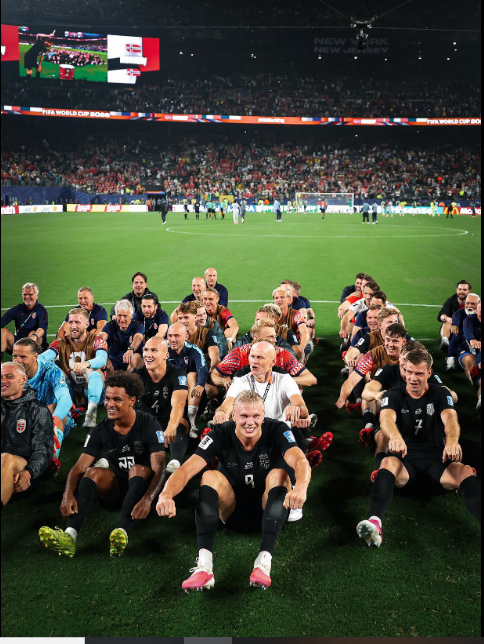
Torstein directs the entire performance from the front of the stand using a drum.
“I stand in front of the stand with my drum. I strike it twice, then we begin the chant. It’s the pauses that build all the tension before the explosion.”
As Norway advanced through the tournament, organisers refined the choreography even further by introducing a second drum to help synchronise fans sitting in different sections of the stadium.
The players soon joined in as well, celebrating victories alongside supporters with their own Viking Row.
“When the players started doing it with us after wins, that’s when we realised something special was happening,” Torstein said proudly.
Following Norway’s 2-1 Round of 32 victory over Côte d’Ivoire, one memorable moment strengthened the connection between the team and its supporters.
“The players wanted my drum,” Torstein laughed. “I had to run across several sections of the stadium to get it to them. I bought that little second-hand drum back in 2023, and now it’s famous all over the world. After the match, everyone wanted to have their picture taken with it.”
For Froystad, hearing the chant echo through New York was an unforgettable experience.
“Hearing people shouting ‘Ro!’ through the streets of New York was incredible,” admitted Froystad. “It was one of the greatest moments of my life. The other was against Senegal, when the players sat down and performed the Viking Row perfectly in sync with the supporters. I almost cried. It was extraordinary.”
A uniting tradition
Much like Iceland’s famous Viking clap became synonymous with its international success, Norway’s Viking Row has evolved into far more than just a supporters’ chant.
“Supporters from other countries absolutely love it,” said Torstein. “We’ve even done the Viking Row with them before and after matches. That’s what a World Cup is all about, people from different countries coming together and sharing moments like these.”
Norway’s next challenge comes against five-time world champions Brazil at New York New Jersey Stadium, where Norwegian supporters are expected to be vastly outnumbered by Brazilian fans.
However, that does little to diminish Torstein’s excitement. At 30 years old, he had never experienced Norway at a World Cup before this year’s tournament.
“I was only two years old when Norway last qualified. I’ve waited my whole life for this moment. Now we’re playing Brazil in the Round of 16. It almost doesn’t feel real.”
Regardless of the result against Brazil, Norway’s supporters have already created one of the tournament’s most unforgettable stories. The Viking Row has become an enduring symbol of unity, passion and the country’s memorable return to football’s biggest stage.