Advertisement
Anti-GMO activists to hold protests in Kisumu
12th February, 2026 02:30 PM

Anti-GMO activists have intensified their campaign in Kisumu, vowing to fight the use of genetically modified organisms (GMOs) in Kenya through street protests, court action and sustained public mobilisation.
Speaking in Kisumu during a sensitisation forum on Thursday, February 12, 2026, Kilimo Cha Haki convenor Mary Kathomi said her team was in the Nyanza region to mobilise residents and educate them on what they termed as the dangers of GMOs.
She announced plans to hold a peaceful walk in the streets of Kisumu to raise awareness and rally opposition to the controversial crops.
Kathomi faulted the government for legalising GMOs in 2023, claiming the decision was made without adequate public participation.
“We are going to fight GMOs in the streets, in court and in every other way until GMOs are burnt in this country,” she declared.
She described the introduction of GMOs as “food colonisation”, arguing that it concentrates seed production power in the hands of a few individuals and multinational corporations.
Kathomi further accused the government of forcing GMOs on Kenyans instead of supporting the use of indigenous and organic seeds.
She linked the GMO debate to the planned privatisation of the Kenya Seed Company, warning that the move, coupled with the legalisation of GMOs, could disadvantage local farmers.
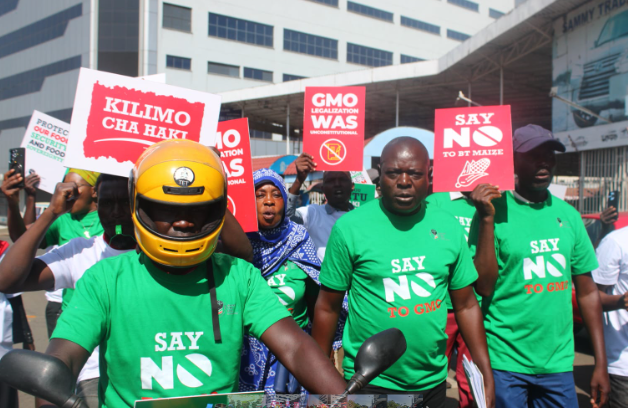
“You legalise GMOs and at the same time list the Kenya Seed Company for privatisation, what are you doing to the Kenyan people?” she posed.
Kathomi also claimed that GMO foods pose health risks and increase farmers’ production costs, alleging that farmers are required to purchase expensive seeds and chemical inputs while still being subjected to taxation.
Appealing to residents of Kisumu and the larger Nyanza region, she urged them to critically examine the food they consume and understand the long-term implications of agricultural policies.
GMO Crops
Drawing on history, Kathomi cited the introduction of BT cotton in the region, which she claimed failed to deliver the promised increase in production.
According to her, the project led to soil degradation and the collapse of cotton companies and left farmers in debt.
“As Kenyans, we are saying no to GMOs,” she said.
She added that their movement is pushing for farmer-friendly agricultural policies and accused politicians of advancing legislation that does not reflect the needs of ordinary citizens.
“Our work is literally to call on the government and push for good policies in agriculture,” she said.
Kathomi emphasised the cultural significance of indigenous seeds, noting that in African traditions, seeds were freely shared within communities rather than commercialised.
The group has also said that they have an active case in court.
“We don’t just want to win in court; we want to inform farmers and the general public about the kind of food they are consuming. Today we are sensitising the public to understand what GMOs mean,” she said.
She warned that Kenyans risk spending their hard-earned income on medical bills if they ignore what she described as the harmful effects of GMOs.
“We do not want to work tirelessly only to use our money for hospital treatment. Strongly and without mincing our words, we are going to fight GMOs until they come down,” she added.
Residents who attended the mobilisation echoed similar concerns.
Byron Akelo, a resident of Kisumu, said locals are worried about alleged health effects linked to GMO foods.

“As Kisumu residents, we are tired of the effects that are coming as a result of GMOs, especially on health. People will spend a lot of money after retirement treating diseases like cancer,” he said.
Sheril Mboya, a Kisumu-based farmer, expressed fears about the long-term impact of GMOs on children and farming practices. She said she strictly uses organic manure and advocates for safe food production.
“I want to challenge farmers planting GMOs to know that it is harmful. It can even affect neighbouring farms that practise organic farming. It is now upon us as farmers to stand for ourselves,” she said.
The activists maintained that their campaign will continue across the region as they push for policy reforms and greater public awareness on agricultural choices in the country.