Advertisement
Mauritania: A rare glimpse at one of the world’s least-visited nations
12th July, 2026 08:57 PM
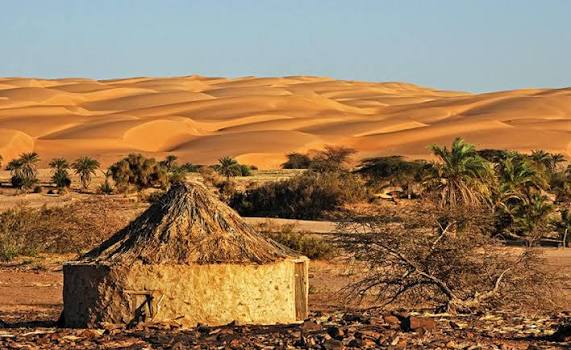
Located almost entirely in the Sahara, Mauritania is home to centuries-old cities, desert oases and a coastal spectacle so vast you can see it from space.
In an age when it’s increasingly easy to explore the furthest reaches of the world – from the tallest mountains to the most remote islands – there are still entire countries that few travellers ever see. One such place is Mauritania.
With approximately 90% of its land located within the Sahara Desert, Mauritania is one of the world’s least-densely populated and least-visited nations.
Because of a lack of tourism infrastructure and security concerns, fewer than 10,000 international travellers arrive each year in the sand-swept, sun-bleached country, compared to several million who visit neighbouring Algeria and Senegal.
But Mauritania hasn’t suffered a terrorist attack since 2011, and according to the Global Terrorism Index, the nation is less affected by terrorism than most European nations.
During a recent three-week solo journey, I used a mixture of public transportation and 4×4 hired pick-ups to crisscross the nation, and never once felt unsafe.
Along the way, I discovered mythical desert oases, fabled cities that once flourished along trans-Saharan trade routes plied by camel caravans and a fishing culture along its Atlantic coast so rich you can see glimpses of it from space.
After crossing the border from Western Sahara, my Mauritanian odyssey started in Nouadhibou, the country’s second-largest city and its most important fishing port.
Thanks to the Canary Current, which pulls deep, nutrient-rich waters up towards the surface along Mauritania’s northern coast, huge concentrations of sardinella, mackerel, sabres and octopus thrive here.
As such, thousands of fishing pirogues dock along the harbour, waiting for the right conditions to cast their nets. The concentration of boats is so vast that it is even visible from space.
A capital rising from the Sahara
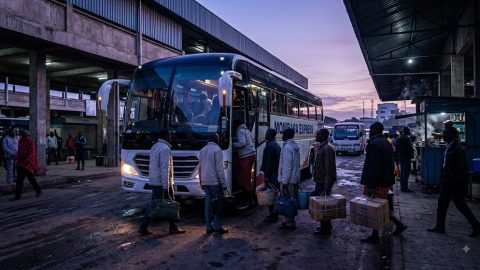
“Welcome to Mauritania!” a man in a small black sedan said to me when I flagged down a taxi in Nouakchott after a seven-hour bus ride south from Nouadhibou. The man refused to accept payment for the ride and then clarified: “I’m not a taxi. I only picked you up because you’re a foreigner and I wanted to know what you think of my country.”
Roughly one-third of Mauritania’s five million people live in its coastal capital, Nouakchott. Dynamic, noisy and vibrant, Nouakchott reminded me of many African capitals at first glance, but with one important exception: it seems to rise magically from the Sahara.
Beyond the city centre, where modern government buildings and mosques line paved roads, most streets remain covered in sand, giving the 1.6-million-person capital the feel of an enormous, welcoming village.
Camel culture
A 30-minute taxi drive east from Nouakchott’s modern sprawl, a more traditional side of the nation emerges. There are roughly two million camels in Mauritania, and residents have long relied on them for everything from meat and milk production to transport. Members of the Mauritanian military even ride them to patrol the border in remote desert areas.
Starting in the 1970s, the remote regions in the far east of Mauritania were gradually connected to the new capital Nouakchott when construction started on the Route de l’Espoir (Road of Hope).
By the early 1980s, the road had reached the city of Néma, roughly 1,100km into the desert, and while it now serves as the nation’s main east-west artery, it still takes more than a day to reach Néma from Nouakchott.
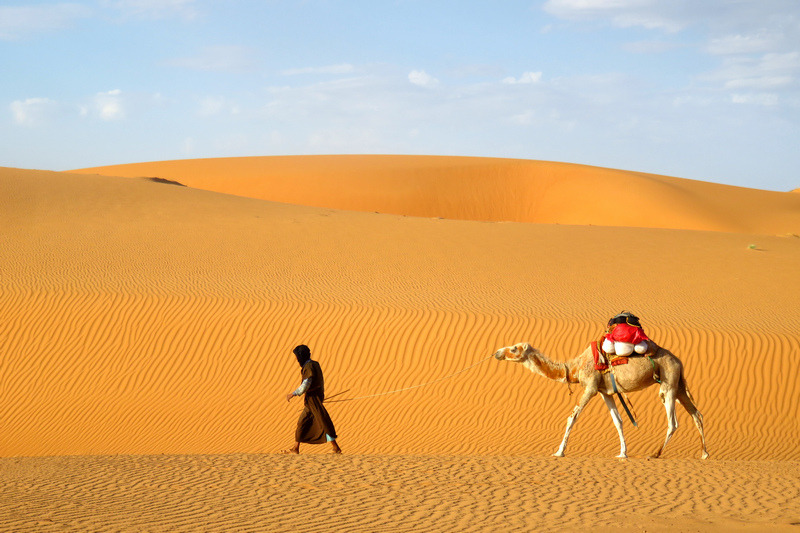
When travelling around Mauritania, there are many police checkpoints. International travellers should show police a fiche (copy of passport and tourist visa) and ask them if the place they’re going is safe before moving on.
Néma is the gateway to the historic caravan town of Oualata, which is part of a UNESCO World Heritage site encompassing four other ancient Mauritanian cities. So from Nouakchott, I piled into a bus and headed east into the desert that regularly stopped so Muslim passengers could pray.
Near midnight, we suddenly stopped in the middle of nowhere, and the driver told us it was time to sleep. Instead of falling asleep on the bus, people laid their mats out in the Sahara and we slept under the Milky Way.
A striking desert outpost
When we finally arrived in Néma, I hired a seat in a shared 4×4 to reach Oualata. After the driver navigated through a maze of tracks in desert sand (and 51 hours after setting out from Nouakchott), I finally arrived in Oualata.
Once there, I unexpectedly met the mayor, Sidaty Dieh, who told me that tourists once flocked to the city en route to Mali and Timbuktu, but since crossing the border is now dangerous, fewer than 30 international travellers now come to Oualata each year.
Visitors to Mauritania need an electronic visa which is valid for up to 30 days. Many international and local tour operators run trips in Mauritania. Solo travellers should speak basic French. Hotels and restaurants are generally limited to cities, while most guesthouses outside the capital offer travellers food.
Oualata is one of the most striking places in the country, both for its historic importance and its geographical isolation. The town is famous for its red-earth architecture decorated with intricate geometric paintings made by local women.
Sadly, there are not many economic opportunities for the new generations, and many leave for Nouakchott and other cities, leaving these stunning old houses partially abandoned. Some others rely on the informal economy, such as working as itinerant bread sellers with a wooden board that operates as a fully mobile storefront.
In Oualata, ancient manuscripts from the trans-Saharan caravans survived, not because of institutions or formal libraries, but because families hid and preserved them across generations in their private homes.
Many families still keep these documents, and after asking a few residents if they knew of any who still have them, they pointed me towards this family, which welcomed me into their living room to show me their ancient manuscripts.
An Islamic pillar
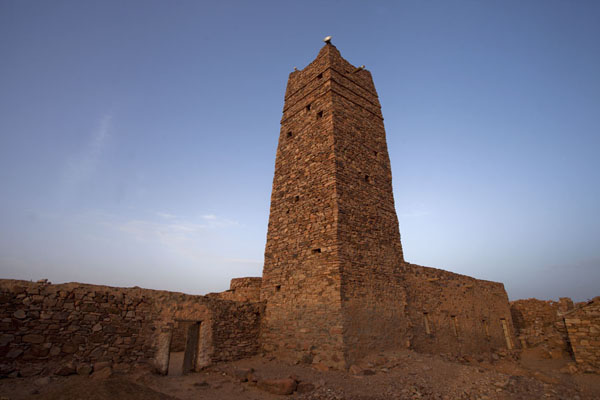
The minaret of the ancient mosque of Chinguetti is said to be the second oldest in continuous use in the Muslim world, and the town is often called the “seventh holiest city of Islam”.
Starting in the 13th Century, it became a major centre of Islamic scholarship, with pilgrims and scholars coming here to study. Today, non-Muslim visitors can only see the mosque from outside a walled enclosure, where this photograph was taken.
Chinguetti is home to several libraries that preserve ancient manuscripts and books on astronomy, geometry, medicine, poetry and Islamic law. Many of these centuries-old texts arrived via trans-Saharan caravans from North Africa, while others were authored by local scholars.
According to local librarian Saif al-Islam, Chinguetti used to have many more libraries, but over the years, many families have left the city and taken their books with them.
Unlike Chinguetti’s ancient mosque, these libraries are open to everyone. With so few international visitors, owners are often happy to open their doors to visitors for a small tip, and explain local history while showing you ancient scripts.
A desert oasis
After so much driving, I decided to rest, recover and eat dates in a desert oasis before leaving Mauritania. Within the nation’s vast interior, oases offer a rare stroke of green amidst the nation’s monotonous earthen colours.
Famous for their clusters of palm trees, these oases sometimes grow in the innermost depths of canyons where they’re shielded from the Sun’s rays.
This is the case of the oasis of Terjit, located just 45km (28 miles) south of the regional capital Atar. In many ways, Terjit represents the beauty and resilience of life in the Sahara – and Mauritania in general.
For centuries, even amidst some of Earth’s most extreme conditions, travellers, scholars and wanderers have been lured to this land to share stories, ideas and discover a distant corner of this vast desert.