Advertisement
What happens when you lose one eye?
13th June, 2026 08:49 PM
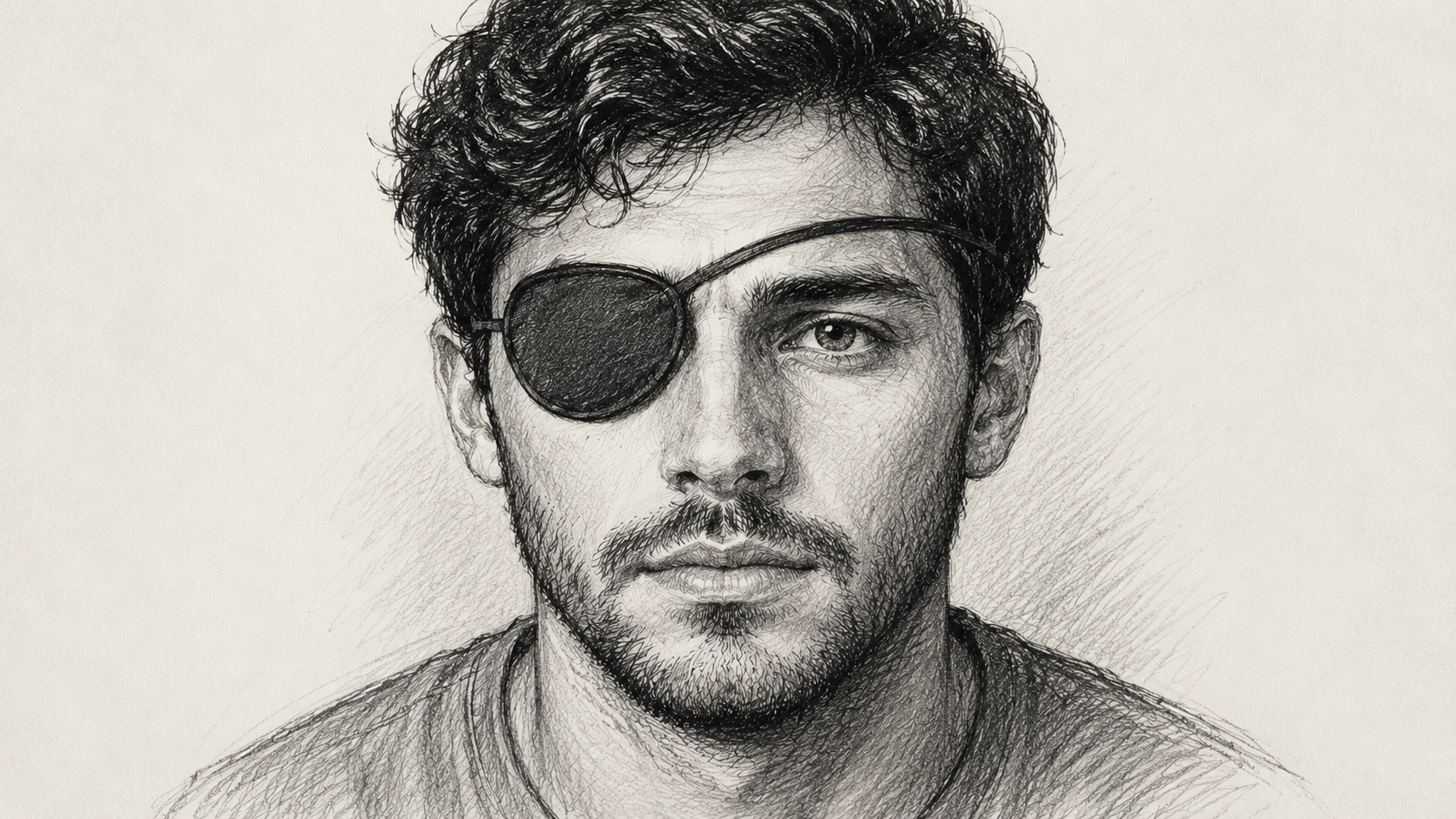
Losing one eye does not mean losing half of your sight, but it does dramatically change how your brain understands the world around you.
Many people assume that someone who loses an eye sees darkness on one side of their vision. In reality, that is not how the brain works.
A person with one healthy eye does not see a black patch where the missing eye once was.
Instead, the brain simply receives visual information from one eye rather than two.
While many people with one eye can still read, work, drive and live independently, the laws of biology, physics and mathematics mean that the world is no longer perceived in the same way.
Two eyes, one picture
Human beings evolved with two forward-facing eyes for a reason.
Think of your eyes as two cameras separated by roughly 5 to 7.5 centimetres.
Because each eye sits in a slightly different position, each captures a slightly different view of the same object.
The brain performs an extraordinary task by combining these two images into a single picture, a process known as binocular vision.
From a physics perspective, this works similarly to a 3D camera system.
The slight difference between what each eye sees, known as binocular disparity, allows the brain to estimate depth and distance.
For example, hold a finger in front of your face and close one eye, then switch to the other.
Your finger appears to shift position slightly. The brain constantly uses these tiny differences to judge how near or far objects are.

This complex calculation happens almost instantly, allowing people to navigate the world without consciously thinking about it.
The missing field of view
One of the first changes after losing an eye is a reduction in peripheral vision.
A healthy pair of eyes provides a horizontal field of view of roughly 200 degrees.
Because the eyes overlap while also seeing slightly different areas, humans can detect movement and objects across a wide visual field.
When one eye is lost, part of that field disappears.
The exact amount varies from person to person, but a blind area develops on the affected side.
As a result, objects approaching from that side can be harder to detect.
This is why many people with one eye learn to turn their heads more frequently.
What may appear to be a simple habit is actually the brain’s way of gathering information that the missing eye can no longer provide.
Judging distance becomes harder
The greatest challenge for most people is depth perception.
With two eyes, the brain estimates distance using differences between the images seen by each eye. The process is similar to triangulation used in surveying and navigation.
When one eye is lost, this biological measuring system largely disappears.
The result is that everyday tasks may initially become more difficult, including:
- Catching a ball
- Pouring water into a glass
- Parking a vehicle
- Climbing stairs
- Reaching for an object
The world does not suddenly become blurry. In fact, a person with one healthy eye may still have excellent visual sharpness.
Instead, the world can appear flatter because there is less information available about depth and distance.
Imagine looking at a photograph rather than standing inside a real-life scene.
The details remain clear, but judging exactly how far away something is becomes more challenging.
The brain learns again
The remarkable part of the story is what happens next.
The human brain possesses an ability known as neuroplasticity, which allows it to adapt to major changes.
After the loss of an eye, the brain begins relying more heavily on what scientists call monocular depth cues.
These include:
- Shadows
- Perspective
- Relative object size
- Motion
- Texture
- Motion parallax
Motion parallax is particularly important. When you move your head, nearby objects appear to move faster across your field of view than distant objects.
The brain uses this difference to estimate distance, even with only one eye.
Over weeks, months and sometimes years, many people become remarkably skilled at using these alternative cues.
Biology cannot fully replace the advantages of two-eye vision.
However, the brain compensates so effectively that many people eventually return to driving, sports, work and everyday activities.
Perhaps the most fascinating lesson is that losing an eye reveals just how adaptable the human brain really is.
While one eye provides less information, the brain learns to extract more meaning from what remains, allowing people to continue navigating the world with surprising accuracy.