Advertisement
Explainer: Why Motorists Association rejects Cabinet’s plan to dual Kiambu Road
12th November, 2025 02:43 PM
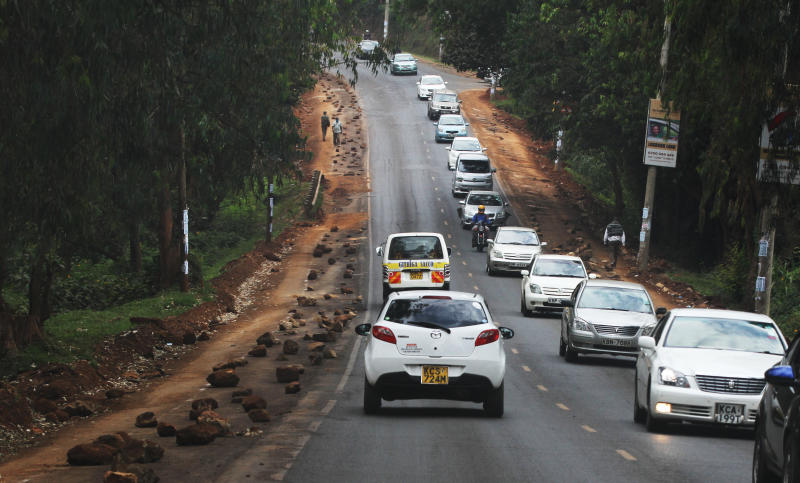
The Motorist Association of Kenya (MAK) has rejected the Cabinet approval of the dualling of the 23.5-kilometre Muthaiga-Kiambu-Ndumberi road (Kiambu Road).
In a series of Facebook posts on Wednesday, November 12, 2025, the association stated that the Cabinet’s decision appears promising on paper. Still, there are several sober, evidence-based reasons why the policy should not be rushed to tick a political box before elections.
Also watch: Residents reject Toll charges on Rironi–Mau Summit expressway
“Examples globally show that high-speed divided highways disconnect people from the businesses right next to them. You’re basically turning a living commercial ecosystem into a through-corridor for distant-bound cars,” MAK argued.
MAK warned that a dual carriageway is not a magic wand, noting it comes with serious social, economic, and environmental costs that must be understood before construction begins.
It cautioned that Kiambu Road’s vibrant business ecosystem, from malls and car showrooms to entertainment spots and small enterprises, would suffer once high-speed, divided traffic replaces the current accessible flow.
Dualling, MAK added, often demands extensive land acquisition, service road redesigns, and demolition of roadside establishments.
Order on Kiambu Road
The association has stated that Kiambu Road needs order and not asphalt expansion, and that it needs a modern transport system to replace the chaos of matatu and predictable buses operating on specified lanes.
Also watch: Residents block Ruiri–Isiolo road over insecurity and livestock theft
Moreover, MAK said Kiambu Road needs proper pedestrian walkways and continuous cycle lanes.
“It needs safe, signalised crossings so residents don’t risk their lives daily. A BRT pilot here would work wonders and would solve congestion without destroying the economic life of the corridor,” the post read in part.

MAK urged the government to conduct a genuine feasibility study, full environmental and socio-economic assessments, and ensure public participation so Kiambu Road residents understand what will be taken, relocated, and how the project will affect their lives.
“Election seasons usually come with cosmetic promises, fresh paint on neglected roads, and quick wins for political optics. But Kiambu Road is not a playground for political grandstanding. It is one of the most economically active and socially vibrant corridors in Kenya,” it added.
The traffic impacts
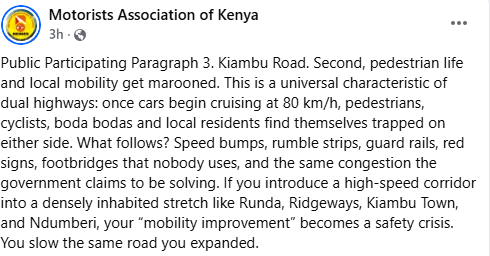
MAK warned that turning the road into a dual highway could harm pedestrian safety and local movement. It noted that when vehicles start cruising at 80 km/h, pedestrians, cyclists, boda bodas, and residents often get trapped on either side.
The Association added that this usually leads to installing bumps, rumble strips, guard rails, warning signs, and footbridges, causing the same congestion the project aims to fix.
“If you introduce a high-speed corridor into a densely inhabited stretch like Runda, Ridgeways, Kiambu Town, and Ndumberi, your ‘mobility improvement’ becomes a safety crisis. You slow the same road you expanded,” MAK stated.
At the same time, it pointed out that Kiambu Road’s worst traffic is only during morning peak hours heading to Nairobi, with movement being slow but steady in the evening.
“This is classic commuter behaviour. You don’t blow up a working road because of a two-hour morning experience. You solve the root cause of that specific peak demand. Globally, this is where Bus Rapid Transit, modern buses, and dedicated transit lanes do the heavy lifting. Not more tarmac. Not more lanes. Congestion is a transport management issue, not a lane-count issue,” it added.
Road quality and drivers
MAK said the Kiambu Road expansion will draw more drivers, noting that widened roads attract new traffic and soon become even more congested than before.
It claimed that this is the reason why wealthy neighbourhoods like Karen, Muthaiga, Lower Kabete, and Kitisuru fiercely protect their narrow, tree-lined roads.
“They know that bigger roads invite more traffic, more chaos, more outsiders, and fundamentally change the area’s tranquillity.”
Lastly, MAK said Kiambu Road is already, by Kenyan standards, a high-quality corridor.
It said the amenities from Muthaiga to Ndumberi reflect a first-world urban strip: malls, showrooms, social spaces, schools, hospitals, and recreation facilities.
“People don’t flock to Karen or Rosslyn or Kiambu Road because the roads are big. They come because the roads are functional, human, calm, and integrated with businesses. Turning Kiambu Road into a high-speed express corridor threatens exactly what makes it valuable,” the statement read.