Blood moon 2025: Why September 21 eclipse will not be visible in Kenya
By Valerian Khakayi, September 8, 2025Unlike the blood moon, the upcoming partial solar eclipse on September 21, 2025, will not be visible in Kenya due to its specific geographical location relative to the eclipse’s path.
It will only be visible in the Southern Hemisphere, though, especially over areas like New Zealand, parts of eastern Australia, and several Pacific islands, including parts of Antarctica. Kenya is not in the eclipse’s path, so it cannot be seen from anywhere in the nation.
During this occurrence, up to 85% of the Sun will be hidden during this deep partial solar eclipse.
The partial solar eclipse on September 21, 2025, will occur at the following times in Coordinated Universal Time (UTC). It is expected to start at 17:29 UTC, which is equivalent to 8:29 pm, maximum eclipse at 19:41 UTC (10:41 pm) and end at 21:53 UTC (12: 53 am on September 22)
However, there is still hope for Kenyans to witness the rare occurrence of solar eclipses in the coming years. For instance, a partial solar eclipse is expected to be visible from parts of Kenya on August 2, 2027.

Partial solar eclipse
This occurs when the Moon passes between the Earth and the Sun, but they are not perfectly aligned.
Blood moon 2025
Kenyans on Sunday, September 7, 2025, witnessed a rare astronomical event, the blood moon, coinciding with Saturn’s alignment, lighting up skies across the country.
From the peaks of Mt. Kenya and the scenic Taita Hills to the sandy beaches along the Coast, Kenyans are enjoying spectacular views of the celestial display.
According to the Kenya Space Agency (KSA), during the eclipse, the moon takes on a deep red hue, earning it the name blood moon.
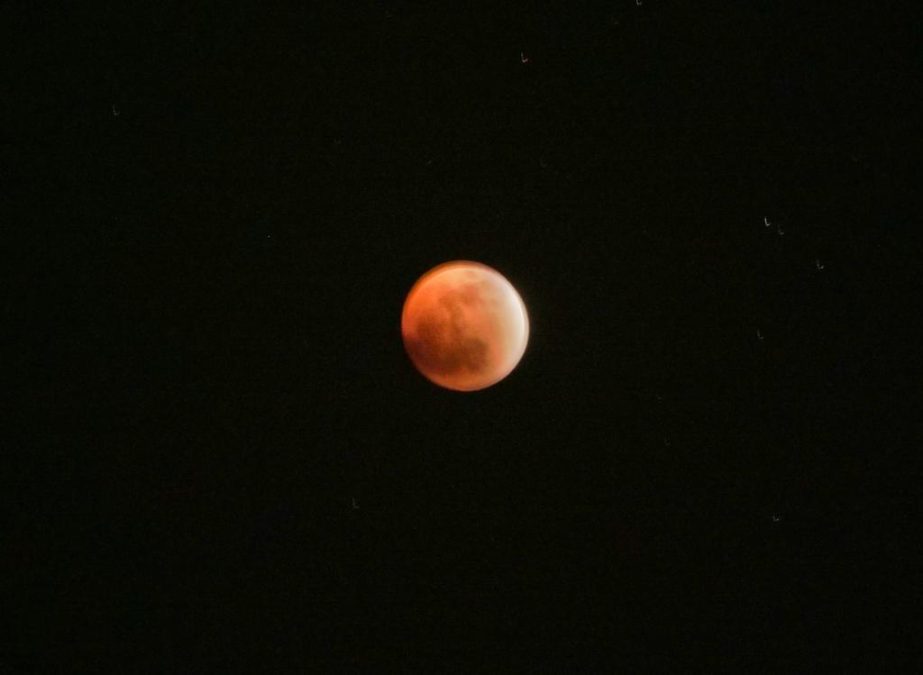
This occurs when the Earth comes between the sun and the moon, casting a shadow that filters sunlight through the Earth’s atmosphere.
“A lunar eclipse happens when the Earth passes directly between the Sun and the Moon, blocking sunlight and casting a shadow on the lunar surface,” KSA disclosed.
“This event can only occur during a full Moon, when the Moon is on the opposite side of Earth from the Sun, making the perfect alignment possible.
The space agency further noted that the Moon turning red during a total lunar eclipse is among the most mesmerising sights and a reminder of the solar system’s graceful mechanics.
“Among all its phases and appearances, the Moon turning a deep, glowing red during a total lunar eclipse is one of the most mesmerising sights in the night sky, a reminder of the graceful mechanics of our solar system,” KSA added.