Advertisement
7 crucial updates on U.S. Visa rules every Kenyan applicant should know
19th August, 2025 04:57 AM
It is important for Kenyans who intend to apply for a U.S. visa to be aware of recent policy changes that may affect their application.
By being aware of these new regulations, you can improve your chances of getting your visa approved and steer clear of common pitfalls.
Here are some of the updates every applicant should familiarise themselves with.
Mandatory Social Media disclosure
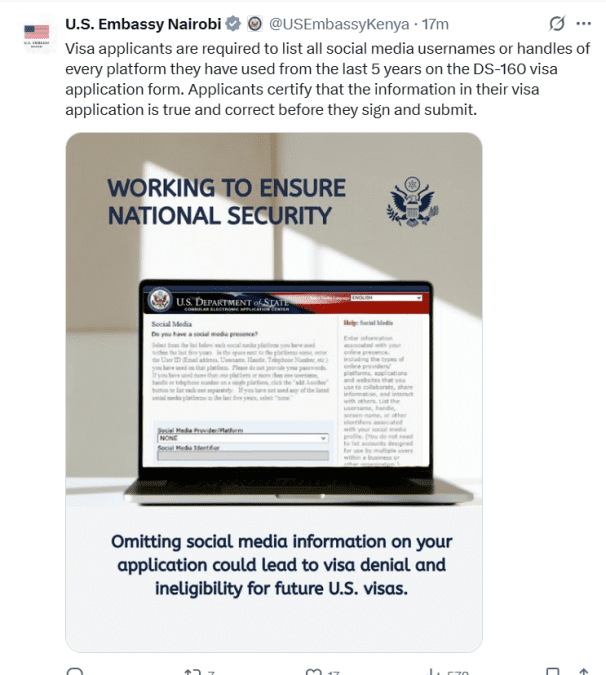
As of June 18, 2025, the U.S. State Department requires all applicants to disclose their social media handles from the past five years on the DS-160 application form to facilitate vetting necessary to establish their identity.
The guidelines will impact all applicants who apply for F visas, which are primarily used by students.
Applicants for the M visas used for vocational students and the J non-immigrant visas used by exchange students will also be impacted.
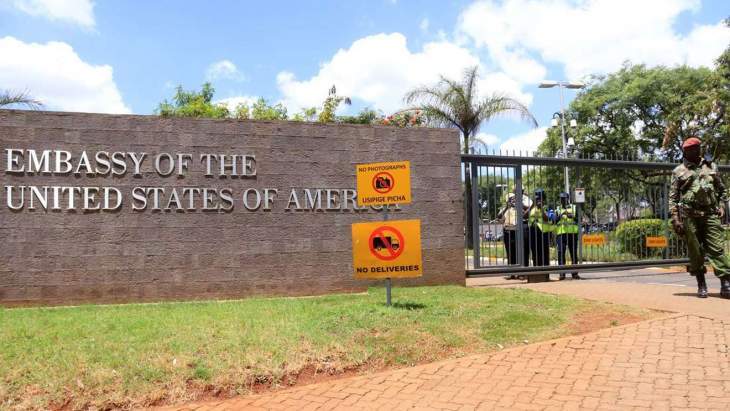
“Effective immediately, all individuals applying for an F, M, or J nonimmigrant visa are requested to adjust the privacy settings on all of their social media accounts to ‘public’ to facilitate vetting necessary to establish their identity and admissibility to the United States under U.S. law,” Notice by the U.S Embassy in Kenya read.
The policy, enacted in 2019, stems from enhanced national security measures. A subsequent 2021 RAND Corporation study revealed that such analysis could detect extremist content with up to 80 per cent accuracy.
The embassy’s renewed emphasis comes as countries tighten immigration controls amid rising global security concerns. The warning also follows a backlog in visa applications caused by the pandemic, prompting the embassy to advise applicants to be transparent and thorough.
Visa expiration does not determine status
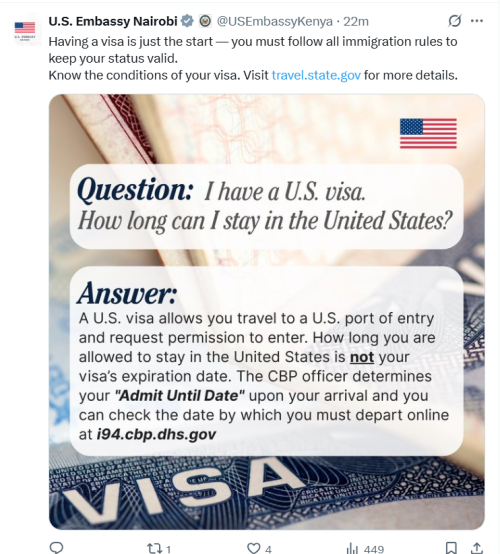
On August 16, 2025, the U.S. Embassy in Nairobi issued a critical clarification for travellers, emphasising that a visa’s expiration date does not determine how long a visitor can stay in the United States.
“A US visa allows you to travel to a US port of entry and request permission to enter. How long you are allowed to stay in the United States is not your visa’s expiration date. The CBP officer determines your ‘Admit Until Date’ upon arrival, and you can check the date online at i94.cbp.dhs.gov,” the US embassy in Kenya said.
Travellers were also advised to visit the state travel official website to know the condition of their visa.
“Having a visa is just the start — you must follow all immigration rules to keep your status valid. Know the conditions of your visa. Visit http://travel.state.gov for more details.”
Skipping classes can lead to Visa revocation
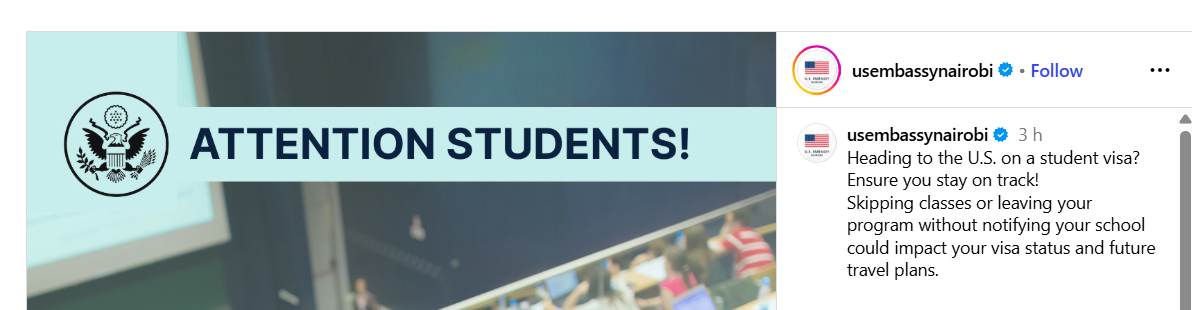
The U.S. Embassy in Nairobi, on August 13, 2025, issued a stern warning to Kenyan students travelling to the United States on student visas, stating that skipping classes or leaving a programme without notifying the respective school could have serious consequences, potentially affecting the student’s visa status and future travel plans.
“Heading to the U.S. on a student visa? Ensure you stay on track! Skipping classes or leaving your programme without notifying your school could impact your visa status and future travel plans,” the statement read.
“If you drop out, skip classes, or leave your programme of study without informing your school, your visa may be revoked, and you may lose eligibility for future U.S. visas.”
Social Media missteps can lead to denial
Omitting social media information or providing false details on the DS-160 form can lead to visa denial or a permanent ban under Section 212(a)(6)(C)(i) of the Immigration and Nationality Act, which deals with wilful misrepresentation.
Visa denial does not equate to permanent ineligibility
According to the U.S. State Department, a visa denial does not automatically make you permanently ineligible.
Applicants may reapply, but they will need to pay the fee, submit a new application, and provide more convincing proof or documentation outlining the reasons for the previous rejection.

Grounds for Visa revocation
Visas can be revoked for reasons such as criminal convictions, fraud, or activities deemed detrimental to U.S. foreign policy.
Stay informed
Visa policies can change, and it’s important to stay informed about the latest requirements. Regularly check the official U.S. Embassy website for updates on visa policies and procedures.