Movie ratings explained: How Kenya’s film regulator classifies what you watch
By Dan Kauna, September 2, 2026When picking a movie at the cinema or streaming a show at home in Kenya, those colour-coded age rating symbols on the screen determine who can watch.
The Kenya Film Classification Board (KFCB) oversees this process to help audiences choose suitable entertainment for themselves and their families.
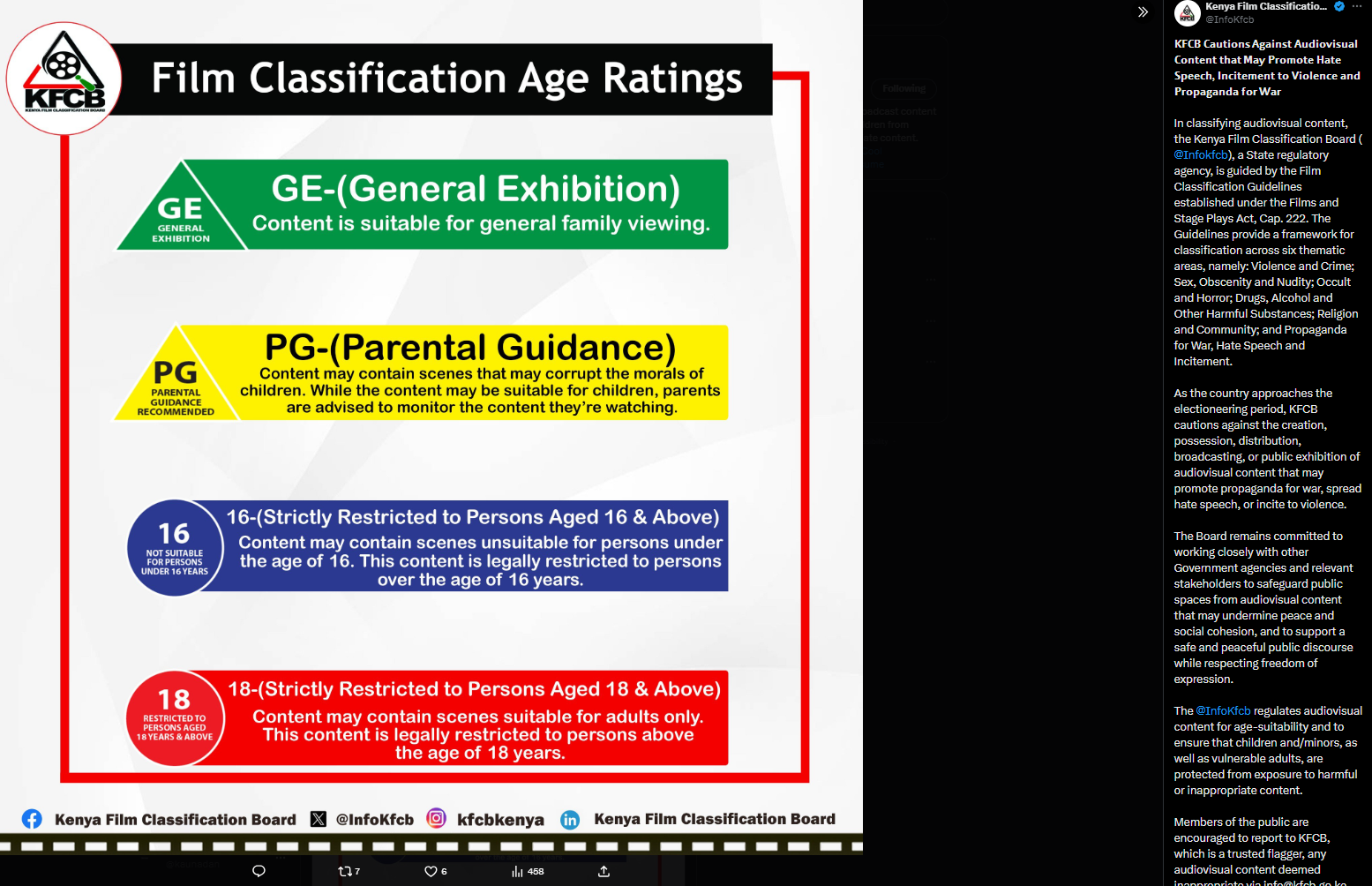
Understanding Kenya’s four movie ratings
Kenya uses a four-tier age rating framework that closely aligns with international systems used by Hollywood and major streaming services.
The most accessible rating is GE, which stands for General Exhibition. Green-coded on official classification charts, content under GE is “suitable for general family viewing.”
This functions much like a global G rating, making it safe for viewers of all ages.
Next is PG, or Parental Guidance. Marked in yellow, the board notes that PG content “may contain scenes that may corrupt the morals of children.”
While the material remains open to younger audiences, “parents are advised to monitor the content they’re watching.”
Internationally, this mirrors standard PG or PG-13 categories.
For more mature movies, Kenya applies strict age limits. The 16 rating, highlighted in blue, covers content that “may contain scenes unsuitable for persons under the age of 16.”
This rating is legally restricted to viewers aged 16 and above, similar to an R rating or TV-14 broadcast abroad.
Finally, the 18 rating, coded in red, is “strictly restricted to persons aged 18 & above.” It contains scenes suitable for adults only.
How content is measured and regulated
The board does not assign these labels at random. In classifying audiovisual content, the state agency is “guided by the Film Classification Guidelines established under the Films and Stage Plays Act, Cap. 222.”
These statutory guidelines evaluate movies across six thematic areas, namely: “Violence and Crime; Sex, Obscenity and Nudity; Occult and Horror; Drugs, Alcohol and Other Harmful Substances; Religion and Community; and Propaganda for War, Hate Speech and Incitement.”
The agency states that it “regulates audiovisual content for age-suitability and to ensure that children/minors, as well as vulnerable adults, are protected from exposure to harmful or inappropriate content.”
Beyond issuing certificates to film exhibitors, the board also operates as a “trusted flagger” where citizens can report inappropriate content directly.