Lynn Ngugi highlights a worrying money trend in Eastleigh
By David Nthua, June 13, 2026YouTuber Lynn Ngugi has come out guns blazing to raise a worrying trend she has noted with some businesses operating in Eastleigh, Nairobi.
Through a post on her X account on Saturday, June 13, 2026, Ngugi claimed that many businesses in the bustling commercial hub do not readily embrace modern payment methods such as till numbers, pay bills or direct bank payments, instead preferring cash transactions.
According to the content creator, customers purchasing goods from some shops are often directed to nearby M-Pesa agents to withdraw cash before completing their purchases.
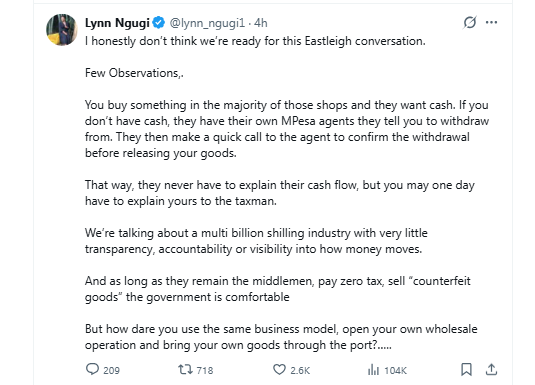
“I honestly don’t think we’re ready for this Eastleigh conversation,” Ngugi wrote.

Cash preferred
Ngugi claimed that in many cases, traders ask customers to make cash payments even when they initially intend to pay electronically.
She further claimed that some businesses direct customers to specific M-Pesa agents before releasing purchased goods.
“You buy something in the majority of those shops, and they want cash.
“If you don’t have cash, they have their own M-Pesa agents they tell you to withdraw from.
“They then make a quick call to the agent to confirm the withdrawal before releasing your goods,” she stated.
The journalist argued that such arrangements raise questions about transparency in the movement of money within one of Kenya’s largest trading centres.
Eastleigh, often referred to as Nairobi’s wholesale capital, handles billions of shillings worth of business annually and attracts traders from across Kenya and neighbouring countries.
Concerns over transparency
Ngugi suggested that the preference for cash transactions could make it difficult to track how money flows through parts of the business ecosystem.
“That way, they never have to explain their cash flow, but you may one day have to explain yours to the taxman,” she said.
She further claimed that there is limited visibility into how some businesses operate financially despite the significant volumes of money exchanged daily.
“We’re talking about a multi-billion shilling industry with very little transparency, accountability or visibility into how money moves,” she wrote.
Debate on taxation
Ngugi’s remarks have sparked debate online, with some Kenyans agreeing that cash-based business models can make financial oversight difficult, while others defended traders, arguing that many small and medium-sized enterprises prefer cash because it provides immediate access to working capital and helps avoid transaction delays.
The discussion also touched on taxation and the informal economy, topics that have increasingly attracted attention from policymakers seeking to widen Kenya’s tax base.
Eastleigh remains one of the country’s most important commercial districts, supplying clothing, electronics, household goods and other products to retailers across East Africa.
As discussions continue online, Ngugi’s comments have once again brought renewed attention to the role of cash transactions, tax compliance and financial transparency within Kenya’s fast-growing wholesale trade sector.