Advertisement
10 killed, 30 injured in car bomb explosion
01st October, 2025 01:49 AM
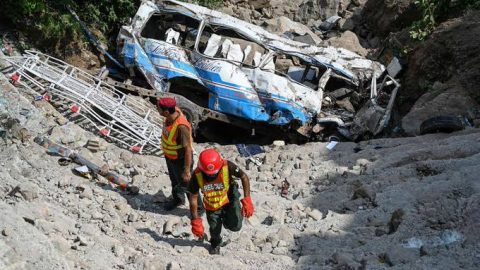
A powerful car bomb blast outside the headquarters of Pakistan’s paramilitary Frontier Corps in the southwestern city of Quetta has killed at least 10 people and wounded more than 30 others, authorities said.
The explosion, swiftly followed by heavy gunfire, tore through the vicinity of Zarghoon Road in Quetta, capital of Balochistan province, on Tuesday.
“Two law enforcement personnel were killed while the rest of the dead were civilians,” Bakht Muhammad Kakar, the provincial health minister, told Al Jazeera.
A security camera video posted on social media showed a vehicle turning towards the regional headquarters of the Frontier Corps and exploding within seconds.
Naresh Kumar, a witness, said he was standing outside his office close to the targeted building when the explosion took place. “My mind just went blank. I got hit by shards of glass in my arm and back. The explosion was just massive,” Kumar told Al Jazeera.
Inam, another injured person who only gave his first name, was brought to the hospital, where he was treated for wounds caused by glass shards. “Our office is right around the paramilitary building. We were working in our office when the explosion totally rocked us, and then everything went dark. I could hear firing which lasted for a while before the law enforcement arrived to take control,” he said.
Balochistan’s Chief Minister Mir Sarfraz Bugti condemned the incident, labelling it a “terrorist attack”. Speaking after the blast, Bugti confirmed that at least four attackers were killed by the security personnel.

Pakistan’s President Asif Ali Zardari also condemned the attack, saying, “The misguided extremists were acting on India’s agenda.” India has not yet responded to the allegation. No group has claimed responsibility.
Balochistan is Pakistan’s largest yet most sparsely populated province, home to about 15 million people. Despite possessing vast reserves of oil, coal, gold, copper, and gas, it remains the country’s poorest province.
The region is also home to Gwadar, a strategic deep-sea port and the centrepiece of the $60bn China-Pakistan Economic Corridor (CPEC). However, Chinese investments have fuelled local resentments, with residents accusing firms of “stealing local resources”, leading to repeated attacks on Chinese personnel and projects.
The province also hosts the Reko Diq reserves, said to contain the world’s fifth-largest copper deposits. Canadian firm Barrick Mining has operated at the site since 2022, while Pakistan recently signed a $500m deal with a US-based company to export critical minerals.
Decades-long resentment has driven a rebellion seeking an independent Balochistan state. Groups such as the Baloch Liberation Army (BLA) and Baloch Liberation Front (BLF) have carried out attacks, with recent violence linked to intensified counter-insurgency operations.
Muhammad Arif, a Quetta-based international relations expert, said the topography of Balochistan makes it difficult for both insurgents and the government. “It is not possible for non-state actors to take control of the region of Balochistan with its vast, difficult terrain, but at the same time, the security of each and every corner of the state is difficult for the same reasons,” he said.
He added that Tuesday’s bombing may have been retaliation. “It is believed that the Baloch Liberation Army and other groups have suffered heavy casualties in the last couple of weeks, with the Pakistani forces helped by Chinese communication equipment, along with drones and Pakistani jet fighters. [Tuesday’s] attack could be a retaliation move,” he told Al Jazeera.