Advertisement
Willis Otieno: Supreme Court settled election timelines, no political extensions
16th August, 2025 06:51 AM

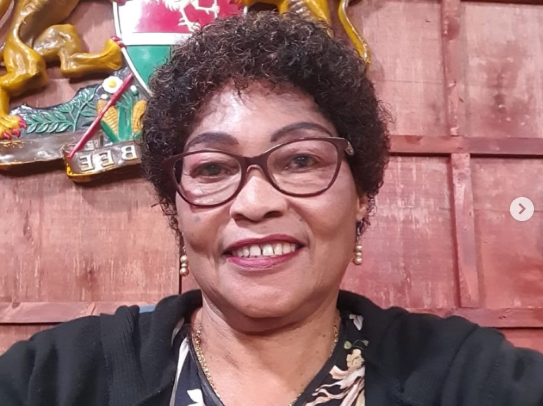
Lawyer Willis Otieno has once again argued that Kenya’s next presidential election must be held in August 2026 and not 2027.
In a statement shared on his X account on Saturday, August 16, 2025, he said the Constitution is explicit on the matter and does not allow for political adjustments to extend terms.
He has based his position on Article 136(2)(a) of the Constitution, which requires a presidential election to be held on the second Tuesday in August, in every fifth year.
“The Supreme Court was clear; after the 2010 Constitution, presidential terms would be shorter than five years. That’s the law, not a suggestion, and no amount of political wish-thinking can stretch the calendar,” Otieno stated.
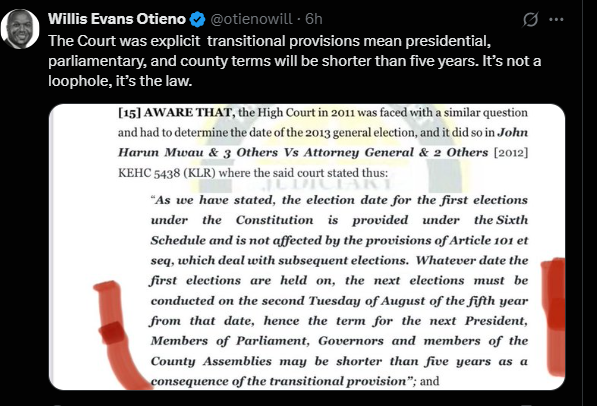
This is the second time Otieno has made this argument. Back in April 2025, he insisted that the election should take place in August 2026, stressing that the phrase in every fifth year means within that year rather than after completing a full five-year term.
“The Constitution is very clear, elections are to be held in the fifth year, not after five years. That means August 2026, not 2027,” he said.
Citing the 2022 election, which was conducted on August 9, Otieno argued that the next one should fall on August 11, 2026, the second Tuesday of August in the fifth year.
“We have a constitutional calendar, not a political one. The idea that we can extend terms based on swearing-in dates goes against the letter and spirit of the Constitution,” he emphasised.
He further drew from past examples. Although President Uhuru Kenyatta was sworn in on April 9, 2013, the next election was held on August 8, 2017, well before the five-year mark. Similarly, Kenyatta’s second term began on November 28, 2017, but the election that ended it took place on August 9, 2022, again before a full five years had lapsed.
Otieno, who came to the limelight during the 2022 presidential petition with his memorable “paka mielo disco” phrase, maintained that the Constitution’s fixed election date overrides the traditional understanding of a five-year term.
That position sits in a line of earlier jurisprudence. In 2012, when the country first asked judges to settle the date question under the new Constitution the Supreme Court declined to give an advisory opinion because the matter had been placed before the High Court. The High Court was directed to hear and decide it in the first instance. This reinforced the forum where election date disputes begin.
On the substance of what “in every fifth year” means, a detailed High Court judgment delivered in 2022 parsed the Constitution and its transitional clauses. The judges stated that the fifth-year language fixes the general election within the fifth year after the previous one and accepted that some terms would run shorter than five years as a result.
They also drew a distinction between when a presidential term ends and when a new one begins, noting that the incumbent remains in office until the next president is sworn in, while the electoral calendar remains anchored to the August date.