UDA remains the most popular party in Kenya – TIFA
By Aloys Michael, September 24, 2025President William Ruto’s party, the United Democratic Alliance (UDA), remains the most popular outfit despite the opposition’s push to wane its influence ahead of the 2027 elections.
This, according to the latest survey findings by TIFA. This second release is based on a TIFA national survey conducted between 23 August and 3 September and released on Wednesday, September 24, 2025.
2,023 randomly selected Kenyan adults (aged 18 and above) across all 47 counties were interviewed at their residences.
UDA is followed by the Orange Democratic Movement Party at 13 per cent. Combined, the two political parties have 34 per cent of the political space.
However, there is a population that does not support any of the political parties; according to TIFA, they hold 31 per cent, nearly half of the UDA’s popularity.
“UDA remains the most popular political party, though the level of support expressed for it (16%) is only half that expressed for no political party at all (31%), the survey shows. Combined with those who indicate they are currently “undecided” as to which party they support, the survey reads.
Additionally, despite UDA being the most popular party, its coalition does not influence that of ODM. The survey indicates that the Azimio coalition has a popularity of 5 per cent compared to Kenya Kwanza at 3 per cent.
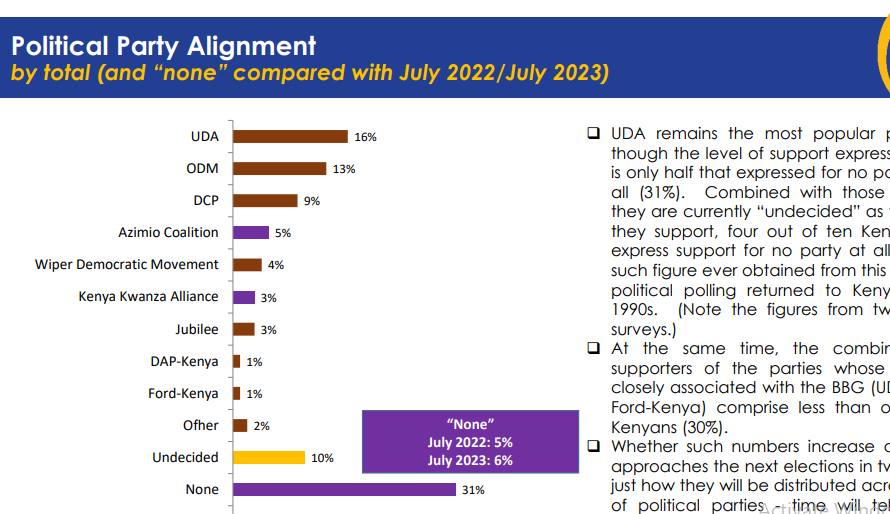
Former Deputy President Rigathi Gachagua’s Democracy for Citizens Party (DCP) is the third most popular party at nine per cent despite its short stay in the political space. It is followed by Kalonzo Musyoka’s Wiper Patriotic Front at 5 per cent.
Notably, according to the survey, four out of ten Kenyans currently express support for no party at all, the highest such figure ever obtained from this question since political polling returned to Kenya in the late 1990s.
“At the same time, the combined figure of supporters of the parties whose leaders are most closely associated with the broad-based (UDA, ODM, and Ford-Kenya) comprises less than one-third of all Kenyans (30%),” the survey shows.
The findings say, “Whether such numbers increase as the country approaches the next elections in two years and just how they will be distributed across the ‘menu’ of political parties – time will tell, though the various by-elections at the end of November should give some preliminary indication. Political Party Alignment by total (and “none” compared with July 2022/July 2023).”