Advertisement
Senate clarifies plans to extend president’s term limit
09th September, 2025 12:34 PM
Caption:Senate clarifies plans to extend president's term limit. VIDEO/K24TV The Senate has raised the alarm over a fake poster on the Constitution of Kenya (Amendment) Bill, 2025, that has been circulating widely on social media platforms, stating that the bill seeks to extend presidential term limits and create a prime minister post.
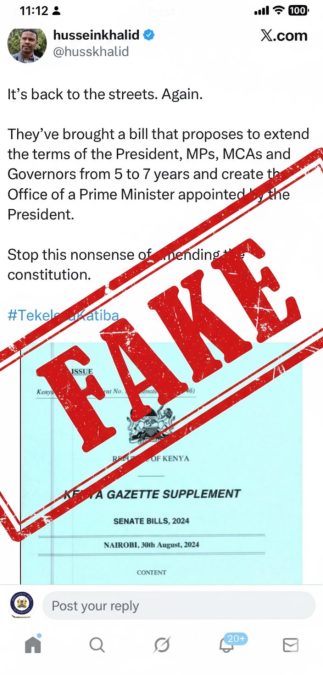
In an official statement posted on its verified X account on Tuesday, September 9, 2025, the Senate dismissed the poster as misleading, stamping the document with a bold red “FAKE” warning to alert the public.
“This information is incorrect. A review of the official Constitution of Kenya (Amendment) Bill, 2025, shows that the claims being made are false. Here are the facts based on the contents of the bill,” the Senate said.
Also Watch: Willis Otieno: Bill seeking to extend term limits is unconstitutional
According to the Senate, while clarifying the post said the bill does not extend term limits, also the bill does not amend the articles of the Constitution that deal with term limits for all elective positions.
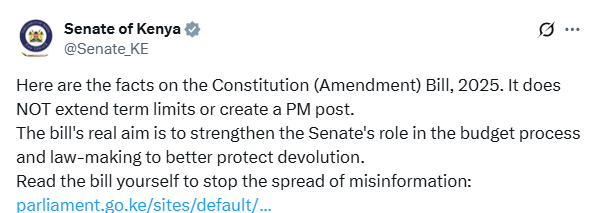
“The Bill Does NOT Extend Term Limits Nowhere in the Constitution of Kenya (Amendment) Bill, 2025, is there any proposal to extend the terms of office for the President, Governors, MPs, or MCAs from five to seven years. The bill does not amend the articles of the Constitution that deal with term limits for these elective positions,” the Senate said.
The Senate has further clarified that the bill does not create a prime minister post as purported across various social media platforms.
“The Bill Does NOT Create a Prime Minister Post. The bill makes no mention of creating the Office of the Prime Minister or any other new position within the executive branch. The proposed amendments do not alter the existing structure of the national executive,” the Senate wrote.
Posts on Social Media about the Bill
Notably, the clarification follows a false post labelled “Senate Bills 2024” and dated 30th August, 2024, with a Senate stamp that has been widely circulated across social media platforms.
Various individuals took to their X accounts, ranting about the bill; among them were lawyer Willis Otieno and human rights activist Hussein Khalid.
Also Watch: Government leaders unite to champion SHA rollout
Human rights activist Hussein Khalid shared the fake post with a loud caption, ‘It’s back to the streets again.’
“It’s back to the streets. Again. They’ve brought a bill that proposes to extend the terms of the president, MPs, MCAs, and governors from 5 to 7 years and create the office of a prime minister appointed by the president. Stop this nonsense of amending the constitution,” Khalid wrote.
On the other hand, lawyer Willis Otieno castigated the context of the poster, saying the bill is unconstitutional at its root.
He further argued that Article 1 of the Constitution vests sovereignty in the people, and the people expressly limited the terms of elected office to 5 years under Articles 101, 102, 180, and 136.
“Further, creating a prime minister appointed by the president dismantles the separation of powers and reintroduces the imperial presidency through the back door. The Constitution of Kenya, 2010, was a covenant with the people after decades of authoritarian abuse. Diluting it to extend terms and centralise power is very wrong,” Willis wrote.
Strengthening devolution
According to Senate, the Bill is primarily designed to strengthen devolution and reinforce bicameralism within Parliament. The proposals aim to strengthen the Senate by granting it an equal role with the National Assembly in the legislative process.
“The primary objective of the Bill is to strengthen devolution and the role of the Senate,” the statement read.
Among the key proposals is ensuring that most bills must be considered and passed by both houses. Additionally, the Bill provides the Senate with a direct role in the budget-making process and oversight of public finances. This includes participation in the approval of key state officers such as the Controller of Budget and the Auditor-General.