Relief as EPRA reduces fuel prices in September-October review
By Aloys Michael, September 14, 2025Kenyans are set to enjoy a slight relief at the pump after the Energy and Petroleum Regulatory Authority (EPRA) announced a reduction in fuel prices for the period September 15, 2025, to October 14, 2025.
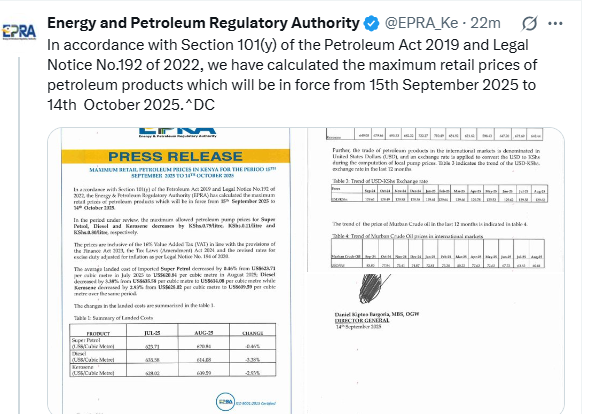
During the review period, the maximum allowable pump prices for Super Petrol, Diesel and Kerosene have each decreased by Ksh0.79, Ksh0.11 and Ksh0.80 per litre, respectively.
Effective midnight, in Nairobi, Super Petrol, Diesel, and Kerosene now retail at Ksh184.52, Ksh171.47 and Ksh154.78.
The prices are inclusive of the 16 per cent Value Added Tax (VAT) in line with the provisions of the Finance Act 2023, the Tax Laws (Amendment) Act 2024, and the revised rates for excise duty adjusted for inflation as per Legal Notice No. 194 of 2020.
The regulator attributes the price adjustments to a decline in the average landed cost of imported fuel. The cost of Super Petrol fell by 0.4 per cent from Ksh 80,826.42per cubic metre in July to US$620.84 in August. Diesel saw a sharper drop of 3.38 per cent, down from Ksh82,373.33 to Ksh79,595.62, while Kerosene declined by 2.93 per cent to Ksh79,026.37 per cubic metre.
The price reduction comes a month after Ndindi Nyoro questioned the justification given by the Ministry of Energy, which attributed the hike to global oil prices despite data showing that the highest global oil prices were recorded last year, not this year.
“These marginal reductions offer some relief to consumers, especially given the recent volatility in global energy markets,” EPRA noted.
The price moderation comes against a backdrop of a relatively stable exchange rate, with the USD-Ksh rate hovering around 129.62 in August 2025, largely unchanged from previous months. Additionally, the global price of Murban Crude Oil, a key benchmark, rose slightly from KSh8,246.91 in July 2025 to Ksh9,046.85 per barrel in August 2025, although it remains below peak levels observed in early 2025.
EPRA clarified that all of Kenya’s petroleum products are imported in refined form and priced according to international market benchmarks, which are subject to currency exchange rates and global oil trends.
Fuel prices in major towns across Kenya will adjust accordingly, with a detailed breakdown provided in annexes accompanying the press release.
The latest review underscores EPRA’s commitment to transparent and data-driven fuel pricing, balancing consumer protection with market realities.
“We continue to monitor global energy trends to ensure fairness in domestic pump pricing,” the authority stated.