Advertisement
Ndegwa Njiru links ghost schools to Ruto’s 2027 election strategy
18th September, 2025 11:11 AM
Caption:Ndegwa Njiru links ghost schools to Ruto’s 2027 election strategy. VIDEO/K24TV Lawyer Ndegwa Njiru has questioned why the Ministry of Education had admitted to the existence of ghost students but denied the presence of ghost schools, tying it to political strategy ahead of the 2027 General Election.
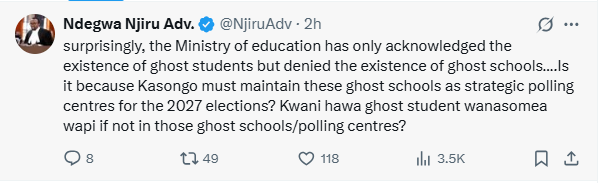
In a statement on Thursday, September 18, 2025, Njiru suggested that the denial was deliberate, linking it to what he described as a plan by President William Ruto’s administration to retain “ghost schools” as strategic polling centres.
“Surprisingly, the Ministry of Education has only acknowledged the existence of ghost students but denied the existence of ghost schools. Is it because Kasongo must maintain these ghost schools as strategic polling centres for the 2027 elections? Kwani hawa ghost students wanasomea wapi if not in those ghost schools or polling centres?” Njiru posed.
His remarks come hours after the Basic Education Principal Secretary Julius Bitok said that the ongoing schools data verification has unearthed ghost learners, with the Ministry of Education predicting that the total number of learners in the country could drop by up to 10 per cent.
He also revealed that the exercise could result in a considerable decrease in the number of schools.
The process has so far verified data for 20,000 schools and led to the disbursement of capitation to the same.
Elsewhere, the former Kenya National Union of Teachers (KNUT) Secretary General Wilson Sossion has sounded the alarm over the existence of ghost students in schools, warning that the scheme has been syphoning capitation funds meant for genuine learners.
Verification of data
On Friday, September 5, 2025, Bitok confirmed that 32,000 public institutions, representing 98 per cent of primary and secondary schools, have complied with the directive.
He revealed that only 3,000 schools have so far received third-term capitation, pending full verification at the Ministry headquarters.
“So far, 3,000 schools have been able to receive capitation after being verified to have the correct data on the correct number of students that are in schools,” Bitok said while overseeing the exercise at Machakos Teachers Training College.
He assured schools that funds would be credited to their accounts immediately upon clearance
It is worth noting that, Isiolo KNUT officials blast the government for funding ghost schools over existing ones.
“We are anticipating that by the end of next week, all of our 32,000 schools will have received their money,” he said.
To qualify, schools must present each learner’s Unique Personal Identifier (UPI) as reflected in birth certificates, alongside their registration number and certified bank account details.
Verification is being coordinated through sub-county education offices.
Bitok defended the rigorous process as necessary to restore accountability in the allocation of public funds, citing previous audits that exposed serious gaps in disbursement.
“We therefore had no option but to verify the data to ensure that every shilling reaches the right school and the right learner. This is about accountability to the Kenyan child and to the nation,” he noted.