Advertisement
Hussein Khalid: Cybercrimes Act worst law under Kenya’s 2010 constitution
22nd October, 2025 03:51 PM

Human rights activist Hussein Khalid has criticised the Computer Misuse and Cybercrimes (Amendment) Act, 2024, calling it the worst piece of legislation under the Constitution of Kenya, 2010.
Khalid, on Wednesday, October 22, 2025, said the law violates fundamental human rights, threatens democracy, and gives the government dangerous powers to silence critics.
“The Computer Misuse and Cybercrimes Act is the worst piece of legislation under the Constitution of Kenya, 2010. Not only is it an affront to the constitution and fundamental human rights, but it is also a huge threat to democracy and accountability,” Khalid said. He added that it was shameful that the same Parliament that claims to represent the people approved such a repressive law. “It is shameful to note that it went through and was approved by the very same parliament that is said to have people’s representatives,” he said.
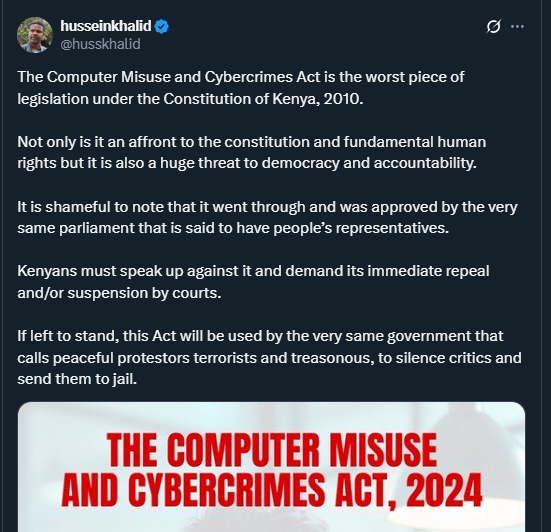
Khalid warned that if the law is not challenged, it could easily be used by the government to suppress dissent and punish those who criticise it.
“Kenyans must speak up against it and demand its immediate repeal and/or suspension by the courts. If left to stand, this Act will be used by the very same government that calls peaceful protestors terrorists and treasonous, to silence critics and send them to jail,” he said.
The new cyber law and its controversial powers
President William Ruto signed the Computer Misuse and Cybercrimes (Amendment) Act, 2024, into law on October 15, 2025. The amendment made Section 27 on cyber harassment stricter and broader than before, drawing concern from digital rights groups and civil society organisations.
Under the new law, anything posted online — including a tweet, comment, video, meme, or blog post — that is considered to cause serious emotional distress, mental harm, or could make someone contemplate suicide can be treated as cyber harassment. It does not matter whether the post was made using a real name or an anonymous account; as long as authorities say it caused harm, the person can be charged.
The law also gives the National Computer and Cybercrimes Coordination Committee (NCCCC) sweeping new powers. The committee can order a page, website, or app to be blocked in Kenya without first obtaining a court order. Police can also arrest suspects and use the committee’s directive as evidence, even before the case reaches court.