Advertisement
Govt clears air amid claims some hospitals have been removed from SHA website
26th August, 2025 02:43 PM

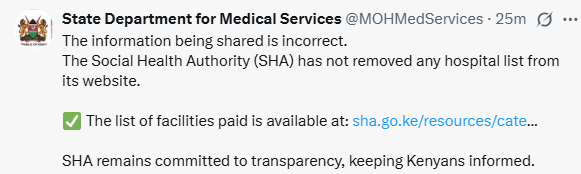
The government has dismissed claims circulating online that the Social Health Authority (SHA) had removed a list of hospitals from its website.
In a statement on Tuesday, August 26, 2025, the State Department for Medical Services and the SHA clarified that no such action had been taken and reassured Kenyans that the information being shared was false.
“The Social Health Authority (SHA) has not removed any hospital list from its website,” the statement read in part.
The Authority explained that the list of health facilities that have received payments under the Social Health Insurance Fund remains accessible to the public. It directed Kenyans to its official website, where the document is available for download.
The government emphasised its commitment to transparency and accountability in the rollout of the Social Health Insurance Fund (SHIF), adding that the public will continue to be updated regularly.
“SHA remains committed to transparency and keeping Kenyans informed,” the Authority assured.
The announcement comes amid growing uproar and scrutiny over irregular disbursements, including payments made to ghost facilities.
Duale’s explanation
This comes after Health Cabinet Secretary Aden Duale revealed how hospitals have devised elaborate schemes to defraud the Social Health Authority (SHA), syphoning billions of shillings meant for patient care.
Speaking on Monday, August 25, 2025, at Afya House in Nairobi, Duale said the fraud has undermined the TaifaCare programme and placed a heavy burden on taxpayers.
The tricks that were exposed during an audit exercise include;
Upcoding
One common practice is upcoding, where hospitals intentionally submit codes for more severe or expensive diagnoses and procedures than those actually performed. This allows providers to receive larger payments than warranted, diverting public funds away from genuine healthcare services.
Falsification of records
Another widespread method is the falsification of records, in which hospitals submit altered or false medical documents to secure higher reimbursements.
This contravenes Section 48(5) of the Social Health Insurance Act, 2023, and Regulation 34(2)(f) of the Social Health Insurance Regulations, 2024.
Conversion of outpatient to inpatient
Hospitals have also been converting outpatient visits into inpatient claims. Routine visits are billed as full hospital admissions to inflate reimbursements, a manipulation that further drains public resources.
This is usually done to receive a higher reimbursement from insurance companies, including government programmes.
Phantom Billing
The most serious scheme is phantom billing, where hospitals claim payments for services, procedures, or medical equipment that were never provided. Unlike upcoding, which exaggerates actual services, phantom billing invents them entirely.
He cited specific cases, including Nabuala Hospital in Bungoma, which submitted false claims for multiple Caesarean sections on the same patient, and Kotiende Medical Centre in Homa Bay, which fabricated clinical documents signed by one staff member for both day and night shifts over consecutive days.
In Nairobi, Vebeneza Medical Centre converted outpatient visits into inpatient claims and made suspicious admissions for employees, while Jambo Jipya Hospital in Mtwapa filed claims for Caesarean sections when patients had normal deliveries.
Duale emphasised that since the rollout of TaifaCare in October 2024, billions of shillings in claims have come under scrutiny.
He urged Kenyans to report suspicious activities through SHA’s toll-free line 147, noting that public vigilance is crucial in protecting taxpayer resources. “Our work has just begun. We will not allow fraud to rob Kenyans of their right to quality healthcare,” he concluded.