Advertisement
David Ndii: We’ve been paying ghost schools since Kibaki era
25th July, 2025 01:01 PM
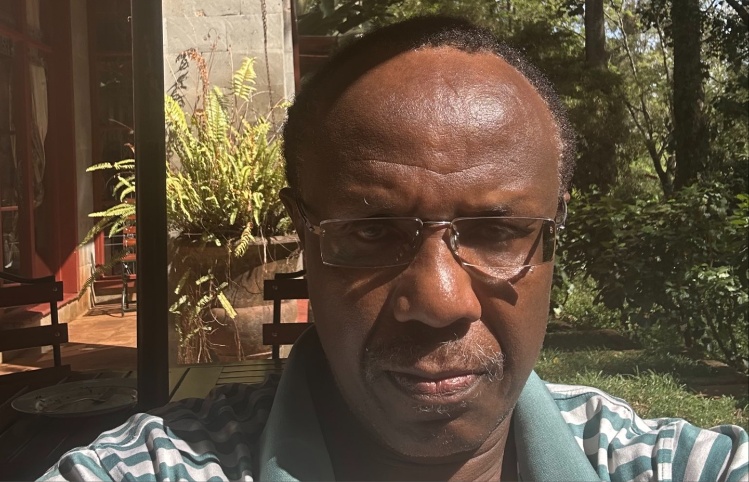
A new wave of public outrage has erupted following comments made by economist and Presidential Economic Advisor David Ndii, who claims that Kenya has been funding ghost schools since the days of the late President Mwai Kibaki.
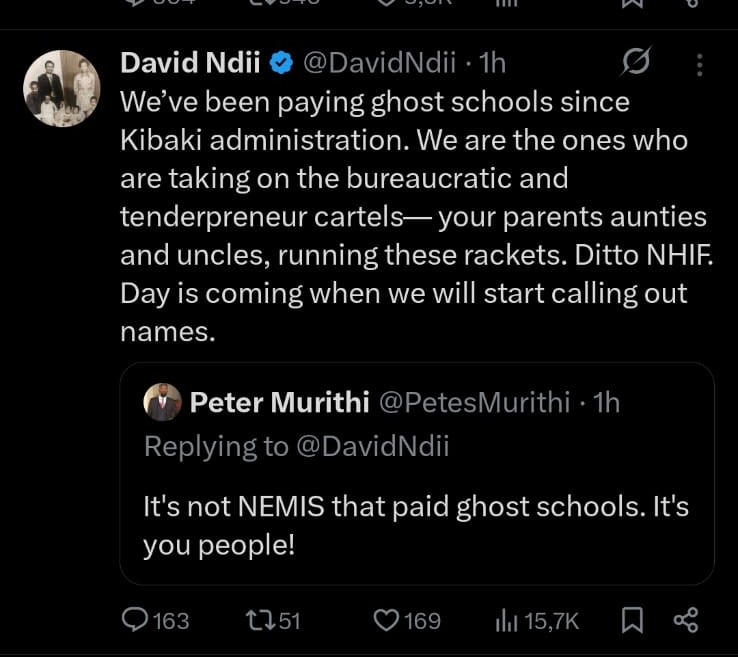
Ndii made the statement on Friday, July 25, 2025, on his X account, in response to remarks made by National Treasury Cabinet Secretary John Mbadi, who had earlier revealed that the government is struggling to allocate limited funds across key sectors due to growing financial constraints.
“We’ve been paying ghost schools since the Kibaki administration. We are the ones who are taking on the bureaucratic and tenderpreneur cartels, your parents, aunties and uncles, running these rackets. Ditto NHIF. A day is coming when we will start calling out names,” Ndii wrote.
Ndii’s remarks came just a day after CS Mbadi addressed the media, outlining the difficult decisions Treasury faces as it attempts to fund critical services, including education, health, and infrastructure.
“We must prioritise. The reality is that money is not enough. Every ministry wants more, but the blanket is short,” Mbadi said, calling for patience and cooperation among stakeholders as the government moves to stabilise its finances.
Ndii’s comments added fire to the ongoing debate about wastage and corruption in public institutions, especially within the education and health sectors. His mention of ghost schools refers to fraudulent institutions that receive government funding without offering real services, an issue that has surfaced in past audits.
While Ndii did not provide specific evidence in his post, his reference to tenderpreneur cartels and corrupt public servants paints a picture of entrenched inefficiencies that continue to drain the national budget. He suggested that the rot cuts across generations, accusing well-connected families of benefiting from state loopholes for decades.
His remarks sparked mixed reactions online, with some Kenyans praising his boldness, while others questioned why such issues are not being decisively addressed despite the current administration’s promises on accountability.
The exchange between Mbadi and Ndii shines a light on the deep financial strain facing the Kenya Kwanza government, now entering its third year in office. It also raises questions about the long-standing systemic failures that have plagued public resource management, issues that President William Ruto’s administration pledged to fix under the Bottom-Up Economic Transformation Agenda (BETA).
While no official government response has been issued regarding Ndii’s claims, pressure is mounting on Treasury and oversight agencies to investigate whether public funds are still being lost to non-existent institutions. Civil society groups have called for full disclosure of budget audits and real-time publication of government disbursement data.
As the dust settles, the exchange has set the stage for a broader national conversation—one that goes beyond numbers and digs deep into the integrity of Kenya’s public financial systems.