Advertisement
KMPDU backs govt’s new licensing policy for foreign doctors and nurses
08th January, 2026 05:07 PM

The Kenya Medical Practitioners, Pharmacists and Dentists Union (KMPDU) has thrown its weight behind the government’s new licensing policy for foreign doctors and nurses, saying the move will help curb exploitation, protect patient safety, and uphold professional standards in the health sector.
In a statement on Thursday, January 8, 2026, KMPDU noted that for years, some private hospitals have exploited foreign doctors by paying wages far below Salaries and Remuneration Commission (SRC) and Collective Bargaining Agreement (CBA) standards.
The union said such facilities have also bypassed work permit requirements, turning the vulnerability of foreign practitioners into a business model.
According to KMPDU, these practices violate Kenyan labour laws and International Labour Organisation (ILO) conventions on equal pay for equal work.
The union warned that exploitation within health facilities harms not only doctors but also patients, as institutions that dehumanise medical professionals inevitably compromise patient safety and erode medical ethics.
“Facilities that exploit doctors endanger patients and undermine the very foundation of healthcare,” the union said.
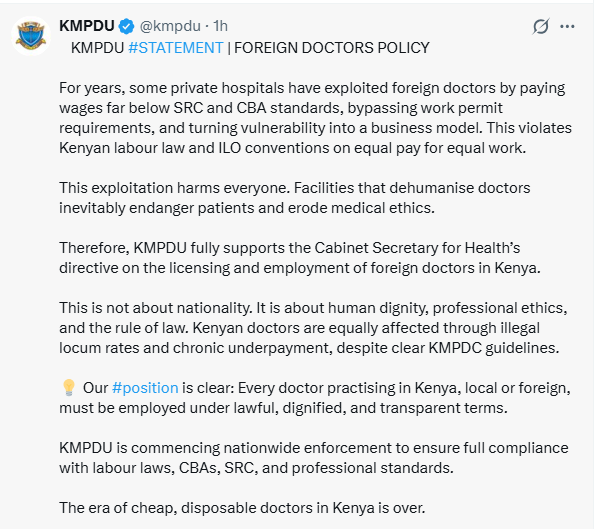
KMPDU therefore expressed full support for the Cabinet Secretary for Health’s directive on the licensing and employment of foreign doctors in Kenya, emphasising that the policy is not driven by nationality but by respect for human dignity, professional ethics, and the rule of law.
The union added that Kenyan doctors have also been affected by similar practices, including illegal locum rates and chronic underpayment, despite clear guidelines issued by the Kenya Medical Practitioners and Dentists Council (KMPDC).
“Our position is clear: every doctor practising in Kenya, whether local or foreign, must be employed under lawful, dignified, and transparent terms,” KMPDU stated.
“The era of cheap, disposable doctors in Kenya is over.”
The licensing policy
This comes a day after the government announced a new health workforce licensing policy that will prioritise the licensing and deployment of qualified Kenyan doctors, nurses, clinical officers, and specialists before considering the routine licensing of foreign health professionals.
In a statement on Wednesday, January 7, 2026, the Ministry of Health said the move is aimed at protecting local professionals and maximising returns on the significant public investment made in training Kenya’s health workforce.

The ministry noted that Kenyan taxpayers fund medical education at both the undergraduate and postgraduate levels, making it necessary and fair to give first priority to locally trained practitioners to serve in the country.
The policy, according to the ministry, is aligned with international best practice and is supported by guidance from global bodies such as the International Labour Organisation (ILO) and the World Health Organisation (WHO).
These institutions consistently recommend that countries prioritise employment opportunities for their own qualified health workers as part of national workforce planning, system sustainability, and resilience.
However, the government clarified that the policy will not apply to countries within the East African Community (EAC).
“The Ministry wishes to emphasise that this policy does not apply to countries within the East African Community (EAC) region. Kenya remains fully committed to regional integration and continues to honour reciprocal recognition agreements within the EAC framework, which allows for mutual recognition of qualifications and regulated professional mobility among Partner States.”