Kenya and neighbours to brace for wetter-than-normal conditions in March–May
By Ascah Mwango, January 27, 2026Kenya and several of its neighbours are expected to experience wetter-than-normal conditions during the March–May (MAM) 2026 season.
This is according to a press statement shared on Tuesday, January 27, 2026, by the IGAD Climate Prediction and Applications Centre (ICPAC).
The outlook shows a 45% probability of above-normal rainfall across much of the Greater Horn of Africa, including central and western Kenya, Uganda, Rwanda, Burundi, Tanzania, Ethiopia, South Sudan, northern Somalia, and Djibouti.
Meanwhile, western and eastern South Sudan, north-eastern and south-western Kenya, coastal Tanzania, and isolated parts of Somalia, Uganda, and Ethiopia have a 40% chance of near-normal rainfall. Coastal Kenya, however, is expected to experience drier-than-normal conditions.
“Communities and farmers should prepare for possible heavy rains, but also remain cautious in areas where rainfall may be late or below normal,” Abdalla Boman, ICPAC’s Director of Climate Services, said.
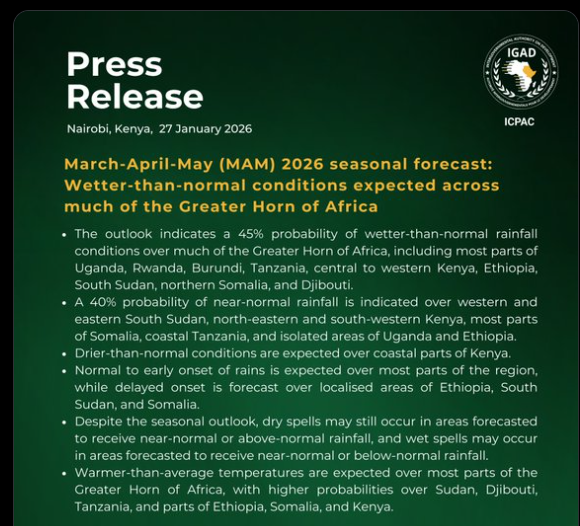
He added that while normal to early rains are expected across most areas, some localised regions in Ethiopia, South Sudan, and Somalia may experience a delayed onset of rains.
According to ICPAC, dry spells may still occur in areas forecasted to receive above-normal rainfall, and wet spells could hit regions expected to get near-normal or below-normal rainfall. This variability makes planning important for farmers, who rely heavily on rain-fed agriculture, as well as local governments managing water resources and disaster preparedness.
The forecast also predicts warmer-than-average temperatures across most of the region, with the highest probabilities of heat in Sudan, Djibouti, Tanzania, and parts of Ethiopia, Somalia, and Kenya. Higher temperatures combined with intense rainfall could increase the risk of floods and soil erosion in vulnerable areas.
“This is the time to review disaster preparedness plans, check drainage systems, and ensure that critical infrastructure can withstand heavy rains. Early action can save lives and reduce economic losses.”
Smallholder farmers are urged to consider crop choices and planting schedules carefully, as heavier rains can damage seedlings, while delayed rains could affect planting cycles. Local authorities are being advised to monitor rivers and reservoirs closely to prevent flooding, especially in low-lying and urban areas.
The seasonal forecast comes as countries in the Greater Horn of Africa continue to face the dual challenges of climate change and increasing population pressure on land and water resources.