Advertisement
Explainer: How does KUCCPS placement work?
09th July, 2026 03:50 PM

Every year, hundreds of thousands of Kenyan students wait anxiously for one of the most important milestones after sitting the Kenya Certificate of Secondary Education (KCSE) examination: placement into universities, colleges and Technical and Vocational Education and Training (TVET) institutions through the Kenya Universities and Colleges Central Placement Service (KUCCPS).
For many students and parents, however, the placement process remains confusing. Questions often arise about why one student is admitted to their first-choice course while another with similar grades is not, what happens when courses become full, and how KUCCPS decides who goes where.
The placement exercise is far more than a random allocation of students. It is a structured, merit-based process guided by KCSE performance, course requirements, institutional capacities and students’ preferences.
What is KUCCPS?
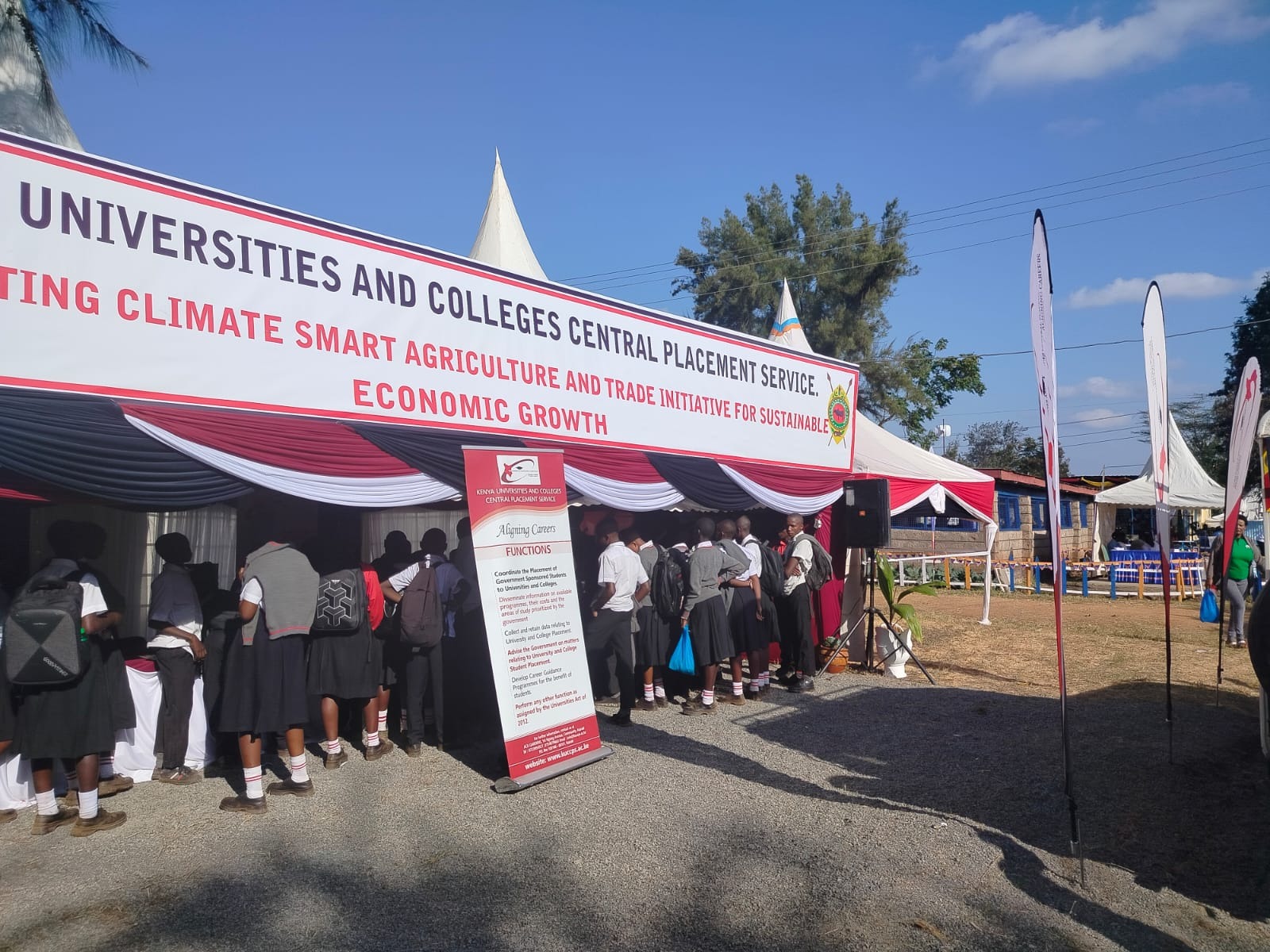
The Kenya Universities and Colleges Central Placement Service (KUCCPS) is the State agency mandated to coordinate the placement of government-sponsored students into public and private universities, TVET institutions, Kenya Medical Training College (KMTC), teacher training colleges and other approved institutions of higher learning.
Apart from placement, the agency also manages course revision, career guidance, inter-institution transfers and applications to various tertiary institutions.
Every year, KUCCPS opens its online portal, allowing eligible students to apply for courses based on their KCSE results before conducting the national placement exercise.
How students make their course selections
The process begins once KUCCPS opens the application portal.
Students log in using their KCSE index number, examination year and password before browsing thousands of available programmes offered by universities, national polytechnics, TVET colleges, KMTC and teacher training colleges.
Applicants are encouraged to choose courses based on their interests, career ambitions and academic strengths rather than popularity alone.
For degree programmes, students usually select several courses in order of preference, beginning with the one they desire most.
This ranking becomes extremely important because KUCCPS always attempts to place a student into the highest-ranked programme for which they qualify.
Minimum requirements matter
Before a student can compete for a course, they must first satisfy the minimum academic requirements.
Every programme has its own entry qualifications.
For example, medicine, engineering, pharmacy, law and architecture generally require high KCSE grades together with strong performance in specific cluster subjects such as Mathematics, Biology, Chemistry or Physics.

Teaching courses, nursing programmes and business degrees also have their own minimum subject requirements.
If a student fails to meet these requirements, KUCCPS automatically excludes that course during placement regardless of whether it was selected as the first choice.
Cluster points play a crucial role
One of the biggest determinants of placement is the cluster point system.
Unlike the overall KCSE grade, cluster points focus on a student’s performance in subjects most relevant to a particular course.
For example, someone applying for engineering will largely be assessed using Mathematics, Physics and other related subjects, while an applicant seeking admission into journalism may be evaluated using different subject combinations.
This means two students with the same KCSE mean grade can have different cluster points depending on their subject performance, giving one a better chance of securing a highly competitive programme.
Competition determines the cut-off points
Many applicants assume that meeting the minimum course requirement automatically guarantees admission.
In reality, this is not how KUCCPS works.
After all applications have been submitted, KUCCPS ranks applicants according to merit.
Courses with thousands of applicants but limited spaces become highly competitive.
Students with the highest cluster points receive priority until all available slots are filled.
The cluster points of the last successful applicant effectively become that year’s cut-off point for the programme.
As a result, cut-off points vary every year depending on the number and academic performance of applicants.
Why some students miss their first choice
Many students qualify academically for a course but still fail to secure admission.
This usually happens because the programme attracts far more applicants than available spaces.
In such cases, KUCCPS places students with stronger cluster points first.
Applicants who miss out are automatically considered for their second, third or subsequent course choices, provided they still meet the entry requirements and vacancies remain available.
This ensures that students are not automatically left without placement simply because they missed one highly competitive programme.
What happens if all preferred courses are full?
If an applicant qualifies for university admission but fails to secure any of the selected courses because of competition or limited capacity, KUCCPS may place the student in another related programme where vacancies still exist.
The placement service aims to maximise available training opportunities while ensuring students are admitted into programmes they qualify for academically.
Institutional capacity also influences placement
Every university and college declares the number of students it can admit into each programme.
These capacities are determined by factors such as available lecturers, classrooms, laboratories, teaching hospitals, equipment and accreditation requirements.
Even if thousands of students qualify for a programme, KUCCPS cannot admit more learners than the institution has been authorised to accommodate.
This explains why some popular courses fill up quickly despite attracting many qualified applicants.
Government-sponsored versus self-sponsored students
KUCCPS primarily handles the placement of government-sponsored students.
These students receive subsidised tuition fees under the government’s higher education funding framework, although funding levels now vary depending on financial need and eligibility assessments.
Students who are not placed through KUCCPS can still seek admission directly through universities as self-sponsored students if they meet institutional admission requirements.
Can students change courses after placement?
Yes.
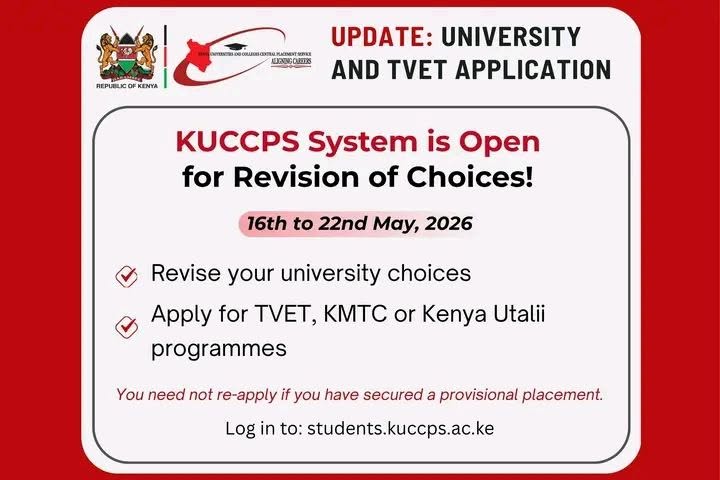
Students who are dissatisfied with their placement are allowed to apply for an inter-institution or inter-programme transfer through the KUCCPS portal.
Transfers are only approved after both the releasing and receiving institutions agree and provided the student meets the entry requirements for the new course.
What if a student is not placed?
Not every applicant is placed during the initial exercise.
This may happen because of ineligibility, incomplete applications or failure to meet course requirements.
KUCCPS normally opens subsequent application windows to fill remaining vacancies in universities, TVET institutions and colleges, giving eligible students another opportunity to secure placement.
Why choosing wisely is important
Education experts consistently advise students against selecting courses solely because of prestige or peer influence.
Instead, applicants are encouraged to consider their strengths, career goals, labour market demand and genuine interests before making their choices.
A carefully selected list of realistic course options significantly increases the chances of securing placement while also ensuring long-term career satisfaction.
Author
Steve Ireri
Steve is a senior writer with over four years of experience in digital journalism. His focus is on the showbiz and human interest stories. Emails: [email protected] , [email protected]
View all posts by Steve Ireri