Lillian Ng’ang’a says Kenya should follow Australia’s move to block under 16 from social media
By Paulette Mboga, December 10, 2025Lillian Ng’ang’a has called for Kenya to adopt Australia’s new policy that blocks children under 16 from using social media.
On Wednesday, December 10, 2025, she shared a screenshot of a news item about the move and captioned it saying, “Kenya should do the same.”
Also watch: Kenya ranked among Africa’s top countries in internet connectivity
Her statement comes as Australia becomes the first country to introduce such a nationwide ban. Australia announced on Wednesday that all under-16s are now restricted from accessing major social media platforms.
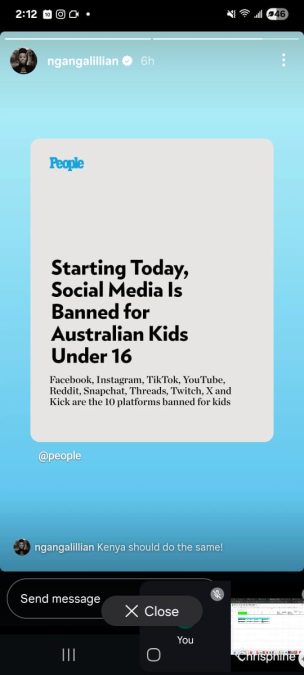
This includes TikTok, X, Facebook, Instagram, YouTube, Snapchat and Threads. Children are not allowed to open new accounts, and any existing accounts belonging to users under 16 are being deactivated. The government says the ban is aimed at protecting young people from harmful content and unhealthy online habits.
A study commissioned in early 2025 found that 96% of children aged 10 to 15 in Australia were active on social media. According to the same study, seven out of 10 children had come across dangerous material online. This included misogynistic posts, violent content, and messages promoting eating disorders and suicide. The report also revealed worrying behaviour targeted at minors.
One in seven children said they had experienced grooming-type behaviour from adults or older children, while more than half reported being victims of cyberbullying.
Why Lillian wants Kenya to take the same path
Lillian believes Kenya should consider a similar approach, especially because of the risks highlighted in the Australian study. She pointed out that the ban is being closely observed by other nations, noting that its impact may influence future global policies.

By saying, “Kenya should do the same,” she echoed the concerns raised by parents, educators and child safety groups who argue that young people are vulnerable to online harm.
Australia’s government says the main issue is how social media platforms are designed. They believe the apps encourage young people to spend long hours on their screens and expose them to harmful content that affects their health and wellbeing. The findings from the study supported this, showing widespread exposure to dangerous trends and messages.
The ban has received mixed reactions. Many parents and child advocates have welcomed it, saying it will help protect children from a space they are not ready to navigate. However, major tech companies and free-speech groups have criticised the move.