Inside Trust Me: The False Prophet: How a self-proclaimed prophet coerced underage girls and turned faith into control
By Ascah Mwango, April 20, 2026Trust Me: The False Prophet is a Netflix documentary that examines how Samuel Bateman, a self-declared religious leader, rose to power within a breakaway fundamentalist group and used belief, fear, and loyalty to control his followers. It is an investigative series that tracks his influence, the experiences of those inside the group, and the eventual legal consequences that brought his leadership to an end.
The story is already unsettling enough, and the documentary understands that restraint, rather than spectacle, gives it more weight and credibility. Instead of rushing to conclusions or pushing a dramatic narrative, it carefully lays out events, allowing viewers to absorb the progression of power, influence, and eventual collapse at a measured pace.
This is not just a story about a man who misused power. It is about the conditions that allowed that power to exist, the systems that supported it, and the people who had to navigate its consequences in deeply personal ways.
Trust Me: The False Prophet presents its narrative without unnecessary embellishment, relying on documented events, recorded material, and firsthand accounts to build its case. The result is a series that is both informative and quietly unsettling, not because of how it is told, but because of what it reveals.
What remains after watching is not shock alone, but awareness and understanding that belief, when placed in the wrong hands, can be shaped into something far more controlling and far more enduring than it first appears.
A leadership gap that became an opening
The events unfold in the aftermath of instability within a rigid religious structure. With authority weakened at the top, space emerges for new leadership, and Bateman steps into that space with certainty and ambition that appear, at least initially, to offer direction and clarity.
He does not present himself as an alternative voice competing for attention. He presents himself as the voice someone with direct spiritual authority and unquestionable legitimacy, a figure whose instructions are not merely suggestions but divine expectations. In a setting where obedience is already embedded into the culture and dissent is quietly discouraged, such claims are not easily challenged or even openly questioned.
Power, in this context, does not need to be seized aggressively or fought for in visible ways. It only needs to be accepted, reinforced, and normalised over time. The documentary highlights how quickly authority can solidify when it is wrapped in familiarity and presented as continuity rather than disruption.
Building influence, one rule at a time
The documentary carefully outlines how Bateman establishes control. It is not sudden, chaotic, or visibly forceful. It is deliberate, patient, and calculated in a way that makes it more difficult to detect until it is already firmly in place.
He uses religious teachings and interpretations to reinforce obedience, gradually tightening his influence over different aspects of daily life, from decision-making to personal relationships. Followers are encouraged to demonstrate loyalty through consistent compliance, while questioning his authority is framed not just as disagreement but as a failure of faith and moral weakness.
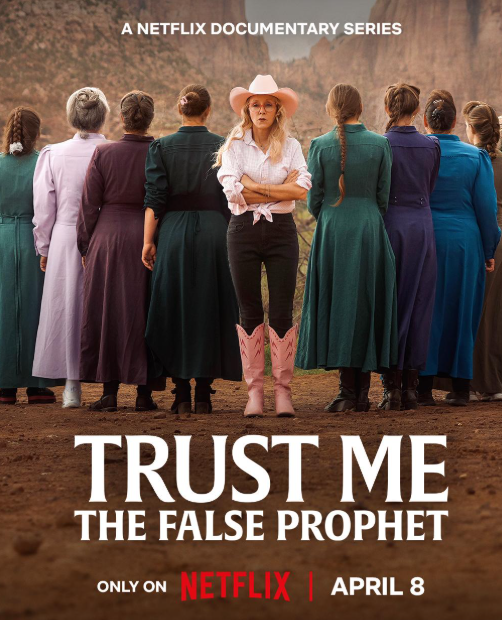
Isolation plays a significant role in maintaining this control. As external perspectives are reduced or entirely removed, his voice becomes dominant, shaping how reality itself is interpreted within the group. Over time, the absence of alternative viewpoints creates an environment where his version of truth becomes the only available reference point.
The series does not dramatise these developments or present them as shocking twists. Instead, it presents them steadily and methodically, allowing the audience to understand how control can grow in environments where trust is unconditional and authority is rarely challenged.
When observation becomes evidence
A significant part of the documentary’s strength lies in its level of access, which gives it both depth and credibility.
Christine Marie and filmmaker Tolga Katas enter the community under the premise of documenting life within the group. Initially, their role appears observational, focused on capturing daily routines, interactions, and the structure of the community itself. However, as their proximity to Bateman increases, their position begins to shift in subtle but important ways.
What begins as observation evolves into a deeper and more involved investigation as they gain trust and access to more private spaces and conversations. This access allows them to document not only the public face of leadership but also the underlying dynamics that sustain it.
Their work results in recorded material, footage, and documentation that later contribute to exposing the extent of Bateman’s control and influence. It is not presented as a dramatic undercover operation, but rather as a gradual process shaped by timing, trust, and careful navigation of a sensitive environment.
It is a delicate balance, remaining close enough to document effectively while recognising the ethical weight of involvement. The series presents this without overstating heroism or simplifying the risks, focusing instead on the complexity of the process and the significance of the evidence gathered.
Doubt, resistance, and exit
As Bateman’s authority grows stronger and more entrenched, subtle tensions begin to surface within the group. These tensions do not immediately present themselves as open resistance. Instead, they appear as small, quiet moments of doubt, questions that linger, inconsistencies that become harder to ignore, and experiences that no longer align with the beliefs being enforced.
The documentary gives space to individuals who begin to question what they once accepted without hesitation. These moments are portrayed with care and patience, showing that doubt is rarely sudden. It develops gradually, often in isolation, before it becomes something that can be acted upon.
Leaving the group is portrayed as complex, emotionally demanding, and deeply personal. It involves more than physical separation. It requires individuals to step away from a belief system that has shaped their identity, relationships, sense of purpose, and understanding of the world.
The process of exit is not presented as a single moment of clarity or courage. It is shown as a series of difficult decisions, often accompanied by uncertainty, fear, and loss. The documentary allows those who lived through these experiences to speak for themselves, presenting their stories without distortion or simplification.
Accountability and aftermath
Bateman’s arrest and conviction mark a turning point in the narrative, bringing legal accountability to actions that had long been hidden within the structure of the group.
The documentary outlines how investigations, supported in part by the evidence gathered during the undercover work, led to formal charges and eventual sentencing. It presents these developments clearly and factually, without overstating them as a complete resolution.
However, the series avoids presenting this moment as a definitive ending or a clean conclusion. While legal action addresses the actions of one individual, it does not fully undo the effects of his influence.
Some followers remain committed to his teachings, demonstrating that belief can persist even after authority is removed. This continuation of loyalty highlights the depth of psychological and emotional investment that had been built over time.
The system he created may have weakened, but its effects continue to exist in quieter, less visible ways, shaping the lives of those who were once part of it.
A broader examination of belief and authority
Beyond the specific events surrounding Bateman’s actions, Trust Me: The False Prophet expands its focus to explore broader themes related to belief, trust, and authority within closed communities.
It shows how authority can be constructed through repetition, confidence, and control of information, and how belief systems can be shaped when alternative perspectives are limited or discouraged. The documentary also highlights how individuals can come to accept and defend structures that, from the outside, appear clearly problematic.
Importantly, the series does not reduce its subjects to simplified narratives or stereotypes. It approaches them with a level of neutrality and consideration that encourages understanding rather than immediate judgment.
This approach allows viewers to engage with the material more reflectively, recognising the complexity of belief and the conditions under which it can be influenced or reshaped.