Advertisement
Kwambox warns Kenyans against falling for xenophobia narratives online
08th September, 2026 03:22 PM

Kwambox has urged Kenyans to be careful about information and videos shared online about xenophobia, warning against disinformation, propaganda and information bias.
She said people should verify sources before resharing or consuming content that could influence how Africans view one another.
“In a world of disinformation and propaganda, please remember to verify the information and avoid information bias,” Kwambox said on Tuesday, September 8, 2026.
She explained that people need to remain critical of the information they come across, especially when dealing with sensitive topics involving Africans and different communities.
She said social media users should not accept every video or piece of information as true without checking where it came from. Kwambox explained that taking time to verify information can help people avoid being misled by content shared online.
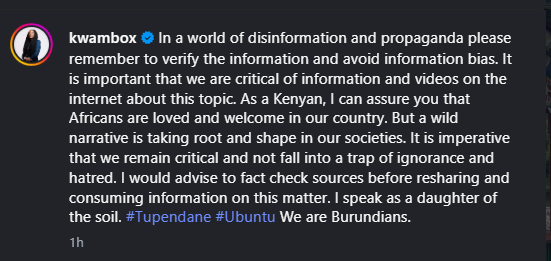
“It is important that we are critical of information and videos on the internet about this topic,” Kwambox said.
She also shared her view on how Africans are treated in Kenya, while urging people not to allow false information to create hatred.
Kwambox calls for caution online
Kwambox said Africans should be careful about a narrative that she believes is becoming more common in societies. She explained that people need to remain alert so they do not become caught up in messages that promote ignorance or hatred.
“As a Kenyan, I can assure you that Africans are loved and welcome in our country,” Kwambox said. She added that the situation requires people to remain critical of the information they receive and share.

Kwambox said a narrative was taking shape in societies and warned that people should not fall into a trap created by misinformation. She explained that checking information before sharing it is important when discussing the issue.
“But a wild narrative is taking root and shape in our societies. It is imperative that we remain critical and not fall into a trap of ignorance and hatred,” Kwambox said. She encouraged people to question the information they encounter instead of spreading it without checking.
She further advised social media users to fact-check their sources before resharing content. Kwambox said this was important when consuming information about the matter, particularly because misleading information can affect how people understand the issue.
“I speak as a daughter of the soil. We are Burundians,” Kwambox said.