Advertisement
KRG The Don reveals he was paid only 3K in music royalties
16th September, 2025 05:13 PM
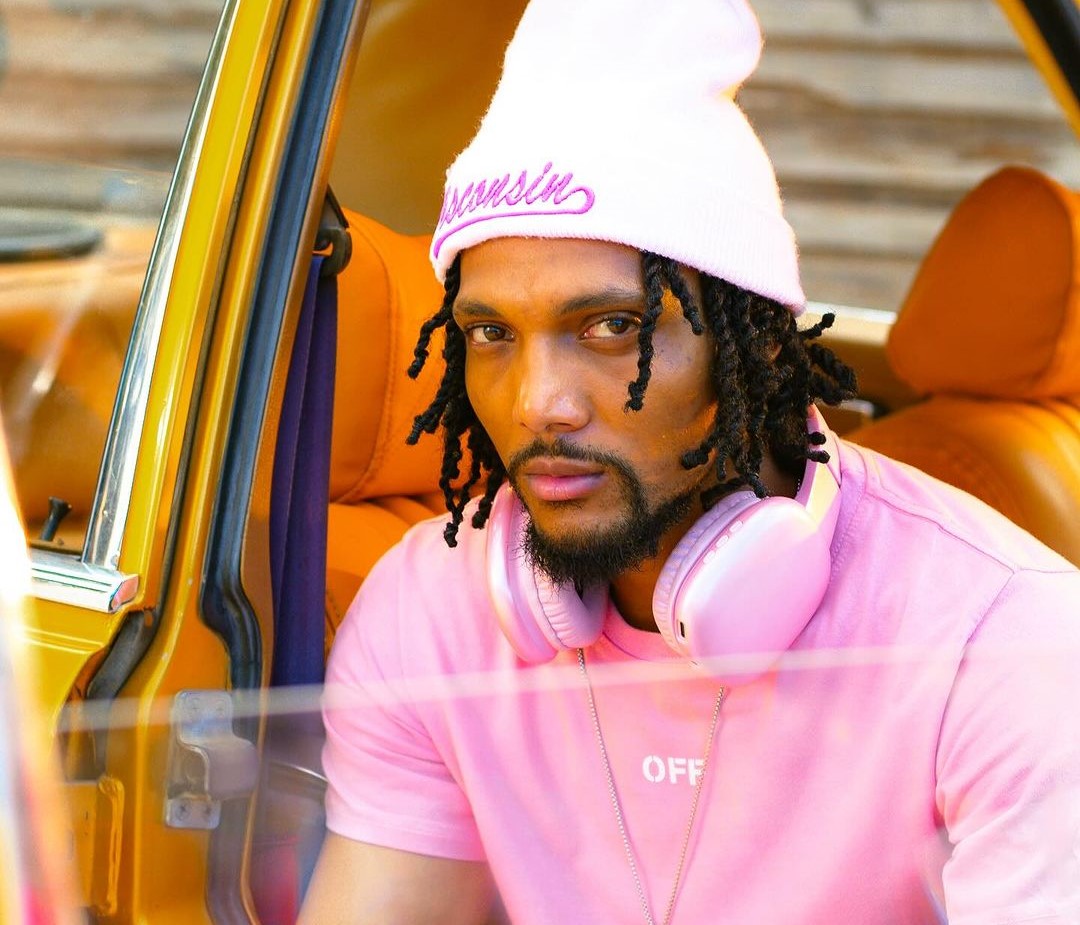
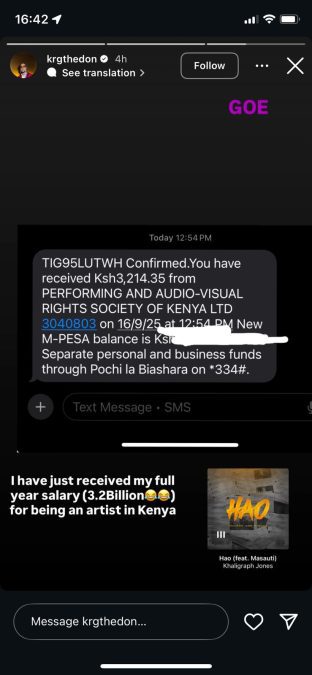
Kenyan musician KRG The Don has revealed that he received only Ksh3,214 as payment for his music from the Performing and Audio Visual Rights Society of Kenya (PAVRISK).
Sharing a screenshot of the Mpesa alert on his Instagram stories on Tuesday, September 16, 2025, KRG described the money as his full-year earnings as an artiste in Kenya.
“I have just received my full-year salary (3.2 billion) for being an artiste in Kenya,” KRG wrote.
His revelation comes months after singer Nikita Kering took the fight for better pay to the African Union. In May, she represented Kenyan artistes at the AU headquarters, where she raised concerns over poor royalties and weak protection of intellectual property rights.
“Today, I represent Kenyan artists at the African Union HQ to address the unfair pay from CMOs and digital platforms and to push for AU support in protecting our intellectual property. It is an honour,” she said in her statement.
Kering explained that the problem partly lies with Collective Management Organisations (CMOs) and digital platforms, which have been repeatedly criticised for paying out very little despite the industry’s growth.
Unfair pay
Kenyan artistes have voiced similar frustrations for years. In 2019, rappers Khaligraph Jones and King Kaka revealed they had each received Ksh2,500 from the Music Copyright Society of Kenya (MCSK). Khaligraph later vowed never to let the organisation collect royalties on his behalf again.
In 2022, musicians Wangechi and Nikita Kering herself said they had received just Ksh1,215.95 from the Performers Rights Society of Kenya (PRISK).
In April 2023, Sauti Sol’s Bien Aime revealed that he had received Ksh14,634 in royalties, questioning how such a figure was possible for one of Kenya’s top-streamed artists.
By March 2024, frustrations remained high. Musician Shizo disclosed that he had not received any royalties for his popular track Rhoda, while Nonini accused CMOs of failing to distribute 70 per cent of collections to artistes as required by law.
A February 2024 report by the Kenya Copyright Board (KECOBO) confirmed glaring disparities in royalty distributions. The report showed that well-known artistes such as Rehema Lugose and Reuben Kigame had been shortchanged and received far less than what they were owed.