Advertisement
Andrew Kibe wants two-thirds gender rule in govt reconsidered
06th August, 2025 05:39 PM

Controversial media personality Andrew Kibe wants the two-thirds gender rule in government reconsidered, terming it impractical and lacking widespread support, even among women.
The two-thirds gender principle, enshrined in Article 27 of the Kenyan Constitution, requires that no more than two-thirds of any appointed or elected public body be of the same gender.
In a statement on Wednesday, August 6, 2025, Kibe argued that government appointments and positions should be based solely on merit rather than gender quotas, questioning why similar rules are not applied across other sectors, such as construction or engineering.
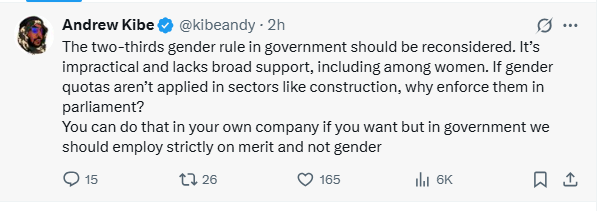
“The two-thirds gender rule in government should be reconsidered. It’s impractical and lacks broad support, including among women. If gender quotas aren’t applied in sectors like construction, why enforce them in parliament?” he posed.
“You can do that in your own company if you want, but in government, we should employ strictly on merit and not gender,” he added.
His remarks come a few weeks after a petition seeking to dissolve Kenya’s Parliament and Senate over failure to implement the two-thirds gender rule has been escalated to Chief Justice Martha Koome for possible empanelment of a constitutional bench.
The petition
The decision was made by Justice Lawrence Mugambi in a ruling dated July 10, 2025.
The petitioners, Margaret Toili, Eddah Marete, and Agnes Ndonji, argue that the 13th Parliament, like its predecessors, has violated the constitution by failing to ensure that no more than two-thirds of any elective public body is composed of one gender.
The petitioners are calling for the dissolution of both the National Assembly and the Senate, alongside orders compelling political parties to comply with the gender rule during nominations.
Justice Mugambi did not rule on the merits of the petition but found that the matter raises substantial constitutional questions warranting consideration by a multi-judge bench.
Referring the case to Chief Justice Koome under Article 165(4) of the Constitution, he emphasised the broader implications of the suit.
“In my view, there is an enduring legal question that characterises all these petitions, and this is the failure by Parliament to comply with the two-thirds gender rule. This question, unless resolved, will keep on recurring with every Parliament that comes up after every general election, hence it cannot plausibly be argued that it is a matter limited to the present Parliament,” Justice Mugambi noted.
The respondents, the Speakers of both houses, had asked the court to consolidate this case with several older petitions filed between 2017 and 2020 that also challenged Parliament’s failure to implement the gender rule.
They argued that the issues raised were nearly identical and involved similar constitutional questions and relief.
But the petitioners opposed consolidation, pointing out that many of those cases targeted the now-defunct 12th Parliament, had already been concluded or dismissed, and were therefore not appropriate to merge with a fresh petition aimed at the 13th Parliament.
Justice Mugambi agreed that consolidation was not within his jurisdiction as a single judge and that the issue required a bench determination.
However, he stressed that the legal issue remained live.