Advertisement
Wamalwa slams govt’s crackdown on youth activism
22nd July, 2025 04:07 PM

Democratic Action Party of Kenya (DAP-K) leader Eugene Wamalwa has issued a sharp critique of the government, accusing President William Ruto’s administration of weaponising Kenya’s criminal justice system to suppress youth activism and stifle dissent.
In a detailed statement shared on X dated July 22, 2025, Wamalwa said the government has turned to the Prevention of Terrorism Act and the Computer Misuse and Cyber Crimes Act to target young Kenyans who are increasingly vocal about police brutality, enforced disappearances, and controversial government policies such as the Finance Bill 2025.
He described the current environment as a “reign of terror” aimed at silencing free expression and constitutional freedoms.
“On the State of the Nation and the Reign of Terror by the Ruto Regime, we wish to state that the criminal justice system has been fully weaponised by this government against its citizens and the law is being used to crush dissent,” read the statement.
Wamalwa’s remarks come as youth-led protests gain momentum across the country, with the Gen Z generation using digital platforms to push for accountability and justice.
Arrests and intimidation
Citing specific cases, Wamalwa highlighted the arrest of Godfrey Mwasiaga, popularly known as Kan Maiyo, a TikTok personality detained on July 9, 2025. Mwasiaga was arrested for calling on the Directorate of Criminal Investigations (DCI) to end abductions and extrajudicial killings of Gen Z protesters, including Denzel Omondi, Rex Masai, and Albert Ojwang,” Wamalwa, who represented Mwasiaga alongside fellow lawyer Biko, said the move was a blatant attempt to silence young activists demanding justice.
The former Defence Cabinet Secretary also pointed to the case of Kibet Bull, an artist abducted for drawing political caricatures, and Rose Njeri, arrested for using her IT skills to educate the public about the Finance Bill. According to Wamalwa, these cases reveal a deliberate government strategy to intimidate and punish young Kenyans using social media to hold those in power accountable.
Misuse of anti-terror laws
Wamalwa expressed concern over the government’s use of the Prevention of Terrorism Act to charge nearly 100 protesters and their supporters with offenses carrying penalties of up to 30 years or life imprisonment. Ironically, Wamalwa reminded the public that he co-authored the law alongside President Ruto during their time in the 10th Parliament. The law was initially designed to counter terrorist groups like Al-Shabaab, not to target peaceful protesters.
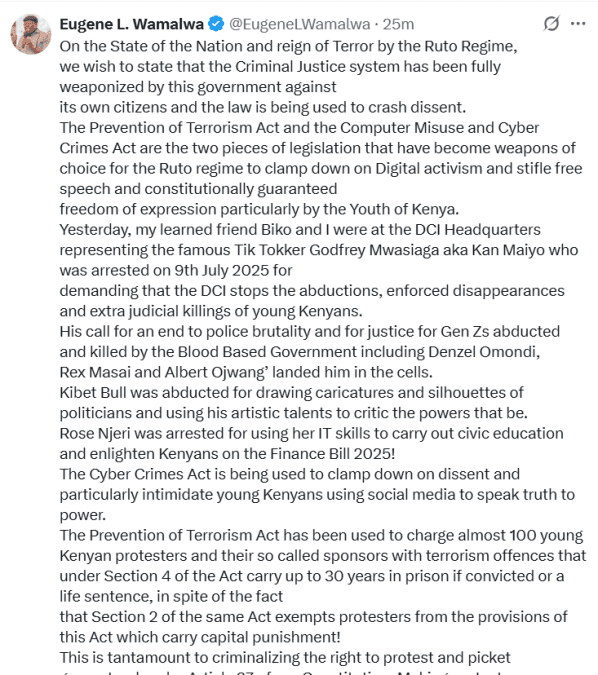
He warned that invoking Section 4 of the Act against protesters, despite Section 2 exempting such demonstrations from capital punishment provisions, creates a legal paradox. This, he argued, turns constitutionally protected protests into high-risk activities that could land young Kenyans in prison for life. The heavy bail conditions placed on arrested protesters, Wamalwa added, are meant to instill fear and discourage civic participation.
Echoes of authoritarianism
Wamalwa also called out the historical irony in the government’s crackdown, reminding President Ruto that Kenya’s 2010 Constitution—which Ruto initially opposed—was born from protests against the authoritarian Nyayo era.
By branding youth activists, human rights defenders like Boniface Mwangi, and opposition figures as terrorists, Wamalwa said the current administration risks dragging the country back to autocracy and eroding democratic gains.
He warned that misusing anti-terror laws to deal with political dissent undermines the real fight against terror. Referring to attacks on Westgate Mall, Dusit, and Garissa University, Wamalwa said trivialising terrorism charges disrespects the memory of victims and their families who have never been compensated.
The growing “Wantam” sentiment among Kenyans, he noted, is a reflection of public frustration with corruption, intolerance, and repression. Wamalwa called for an immediate end to the crackdown on youth activism and urged the government to respect the rule of law and constitutional freedoms.