Advertisement
Trade CS says billions lost after Saba Saba protests
08th July, 2025 08:57 AM

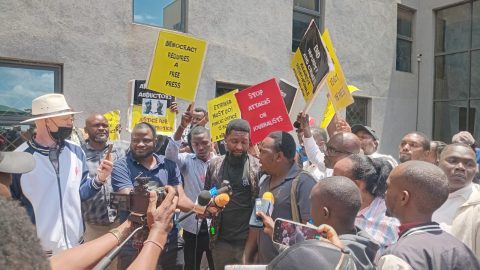
As the nation grapples with the aftermath of recent anti-government protests, Cabinet Secretary for the Ministry of Investments, Trade, and Industry Lee Kinyanjui has voiced deep concern over the devastating toll the unrest has taken on lives and livelihoods.
Posting on his X on Tuesday, July 8, 2025, just hours after the latest wave of demonstrations, Kinyanjui painted a grim picture of a country in pain following the deaths and massive losses amounting to billions.
“As the smoke settles, the extent of the damage and loss of life is becoming clear. Billions have been lost, and many lives disrupted, some forever. An abomination has visited the land,” he stated.
The protests, driven by public outrage over the cost of living and demands for government accountability, have left a trail of destruction across multiple counties. Kinyanjui stressed the human cost of the unrest.
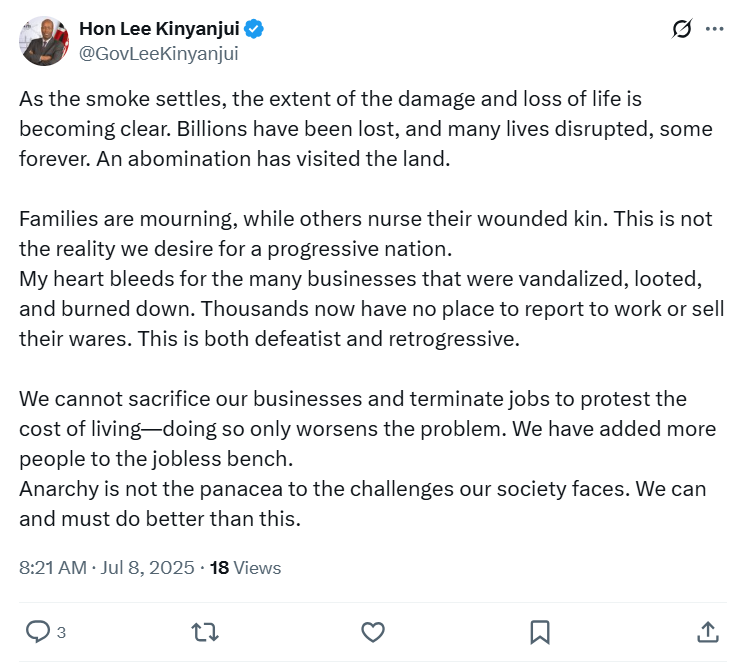
“Families are mourning, while others nurse their wounded kin. This is not the reality we desire for a progressive nation,” he added.
Jobs lost, businesses destroyed
Kinyanjui expressed heartbreak over the economic devastation triggered by the violence. He said the destruction of commercial hubs and informal businesses has pushed more Kenyans into joblessness and despair.
“My heart bleeds for the many businesses that were vandalised, looted, and burnt down. Thousands now have no place to report to work or sell their wares. This is both defeatist and retrogressive,” he said.
The former county boss warned that while the frustrations behind the protests are valid, the outcomes are self-defeating. “We cannot sacrifice our businesses and terminate jobs to protest the cost of living—doing so only worsens the problem. We have added more people to the jobless bench,” he noted.

The Kenya National Commission on Human Rights (KNCHR) on July 7, 2025, reported a grim update from the ongoing Saba Saba demonstrations, documenting 10 fatalities, 29 injuries, 2 abductions, and 37 arrests across 17 counties.
The commission’s monitoring teams have been deployed nationwide to track rights violations and assess the human cost of the protests, which have been largely driven by youth-led civil disobedience against state excesses.
KNCHR further observed that heavy police barricades had been erected on major roads and entry points, significantly disrupting the movement of people, particularly in Nairobi County. The restricted access not only hampered demonstrators but also affected emergency response teams, business operations, and essential travel—raising questions about the proportionality and legality of the state’s crowd-control measures.
Violence is not the solution
Kinyanjui cautioned against normalising political violence as a method for expressing public frustration. He urged the public and leaders alike to pursue dialogue and sustainable solutions.
“Anarchy is not the panacea to the challenges our society faces. We can and must do better than this,” he said.
His comments come amid a growing debate on the effectiveness of mass protests, with observers calling for a re-evaluation of civic engagement strategies. While previous efforts have led to some police accountability—42 convictions between 2017 and 2022—recent unrest highlights persistent gaps in governance and justice.
As Kenya navigates this turbulent chapter, Kinyanjui’s remarks serve as a sobering reminder of the need for peaceful, transformative action to safeguard the nation’s progress.