Advertisement
Rare blood moon lunar eclipse to light up skies on Sunday, September 7
05th September, 2025 05:30 PM
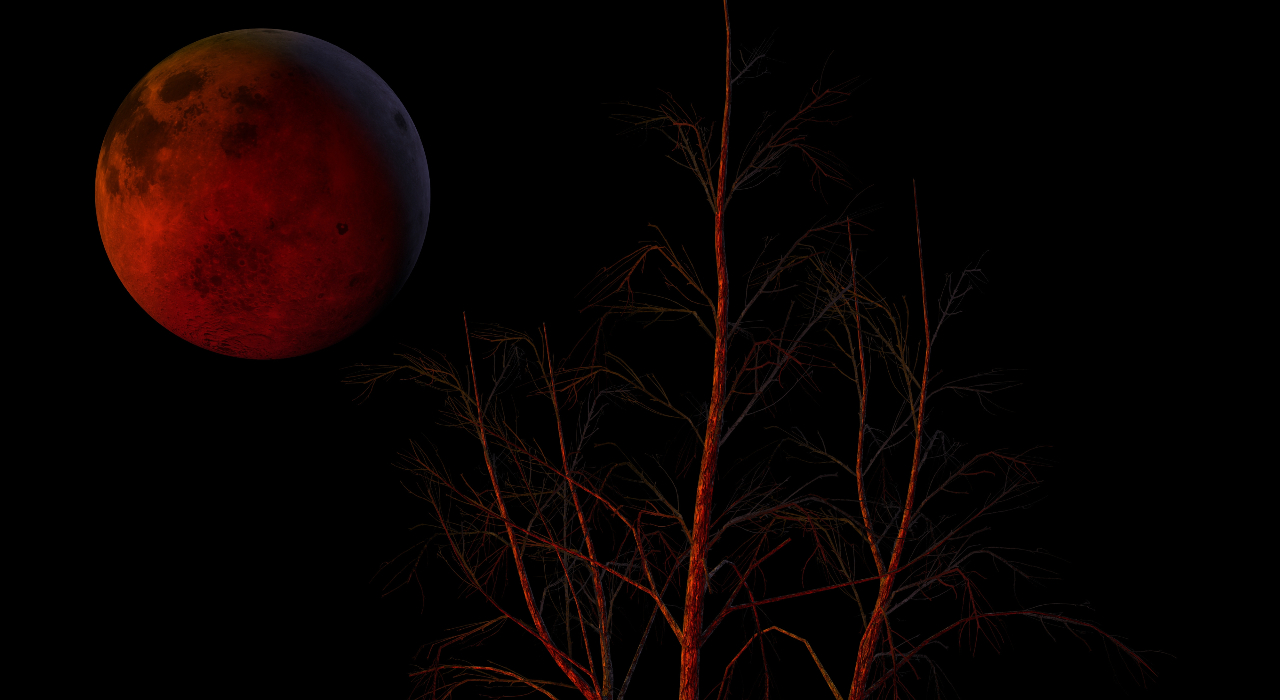
The Kenya Space Agency has announced that on the night of September 7, 2025, people in Kenya and many other places will see a Blood Moon, a red-colored moon in the sky.
Beyond its scientific importance, the Moon also offers breathtaking celestial shows. One of the most spectacular is the lunar eclipse, when Earth moves directly between the Sun and the Moon.
During this cosmic alignment, the Earth blocks sunlight and casts a shadow across the lunar surface. Such an event can only happen during a full moon, when the alignment is perfectly in place.
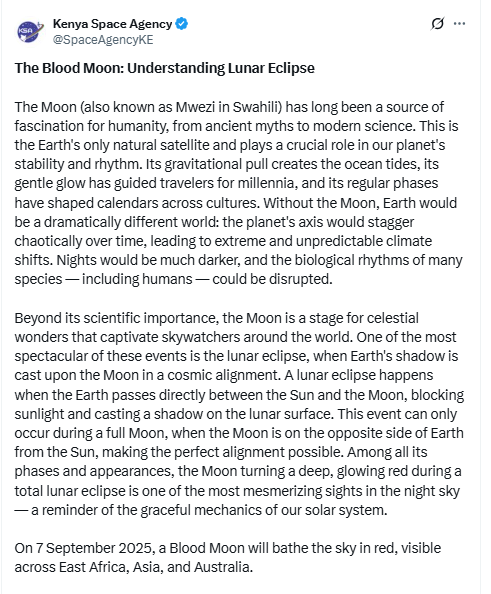
Among all its appearances, perhaps none is as mesmerising as a total lunar eclipse, when the Moon transforms into a glowing red orb. This phenomenon, popularly known as a Blood Moon, has captivated skywatchers for centuries, inspiring both awe and wonder.
Mark the date
According to the Kenya Space Agency, on September 7, 2025, stargazers across East Africa, Asia, and Australia will be treated to this rare and dazzling sight. As Earth’s shadow falls on the Moon, it will glow a deep crimson red, creating one of the most enchanting spectacles in the night sky.
Astronomers say the event will be clearly visible across wide regions, offering a chance for millions to witness the graceful mechanics of the solar system in action. For sky enthusiasts, the 2025 Blood Moon will be more than just a natural event — it will be a reminder of the cosmic dance that connects Earth to its only satellite.
A lunar eclipse is safe to look at directly, unlike a solar eclipse, which needs special glasses. You don’t need any protection for your eyes — you can enjoy it with just your eyes. If you want to see the red Moon in more detail, you can use binoculars or a telescope, but they’re optional.
Where can you see it?
A lunar eclipse can be seen by anyone who is on the night side of Earth when it happens. This is different from a solar eclipse, which can only be seen in a small area.
For the eclipse in September 2025:
- It will be seen fully in Africa, Asia, and Australia.
- It will be seen partly in Eastern Europe.
- It will not be seen in most parts of North and South America, because the Moon will be below the horizon.